
15 Amazon Behavioral Questions Ranked by How Often They Are Asked
What candidates report being asked in 2026 loops, the Leadership Principle behind each, and the specific story structure that scores well.

Amazon behavioral questions are not random.
Every question maps to one or two specific Leadership Principles, and the interviewer is scoring you on whether your story demonstrates that LP with measurable outcomes and clear ownership.
The candidate who walks in with prepared stories tagged to LPs scores meaningfully higher than the candidate who walks in with prepared stories tagged to topics.
This post breaks down the 15 behavioral questions Amazon candidates have most frequently reported being asked in 2026 loops, ranked by reported frequency.
For each, you’ll get the Leadership Principle being probed, the trap most candidates fall into, and the structural elements that separate a 4-out-of-5 answer from a passing one.
Two things to keep in mind as you read.
Every coding round in 2026 also contains behavioral probing.
A behavioral question can show up in any round, not just the dedicated behavioral round. Plan accordingly.
The follow-up questions matter more than the initial answer.
A typical interviewer asks the question, lets you give your 2-3 minute STAR answer, then probes with three to four follow-ups.
The follow-ups are where the round is actually decided. Your prep needs to cover the follow-ups, not just the surface story.
How the Ranking Was Built
The frequency ranking below is synthesized from publicly available candidate-reported feedback across major prep communities (Glassdoor, Blind, levels.fyi, r/csMajors) from 2024 through 2026, weighted toward more recent reports. It is not from internal Amazon data.
Frequency tier 1 (questions reported in 70%+ of loops) covers the top 5.
Tier 2 (50-70% of loops) covers questions 6 through 10.
Tier 3 (30-50% of loops) covers 11 through 15.
Even tier 3 questions appear often enough that you should prepare for them.
TIER 1: Asked in Most Loops (Top 5)
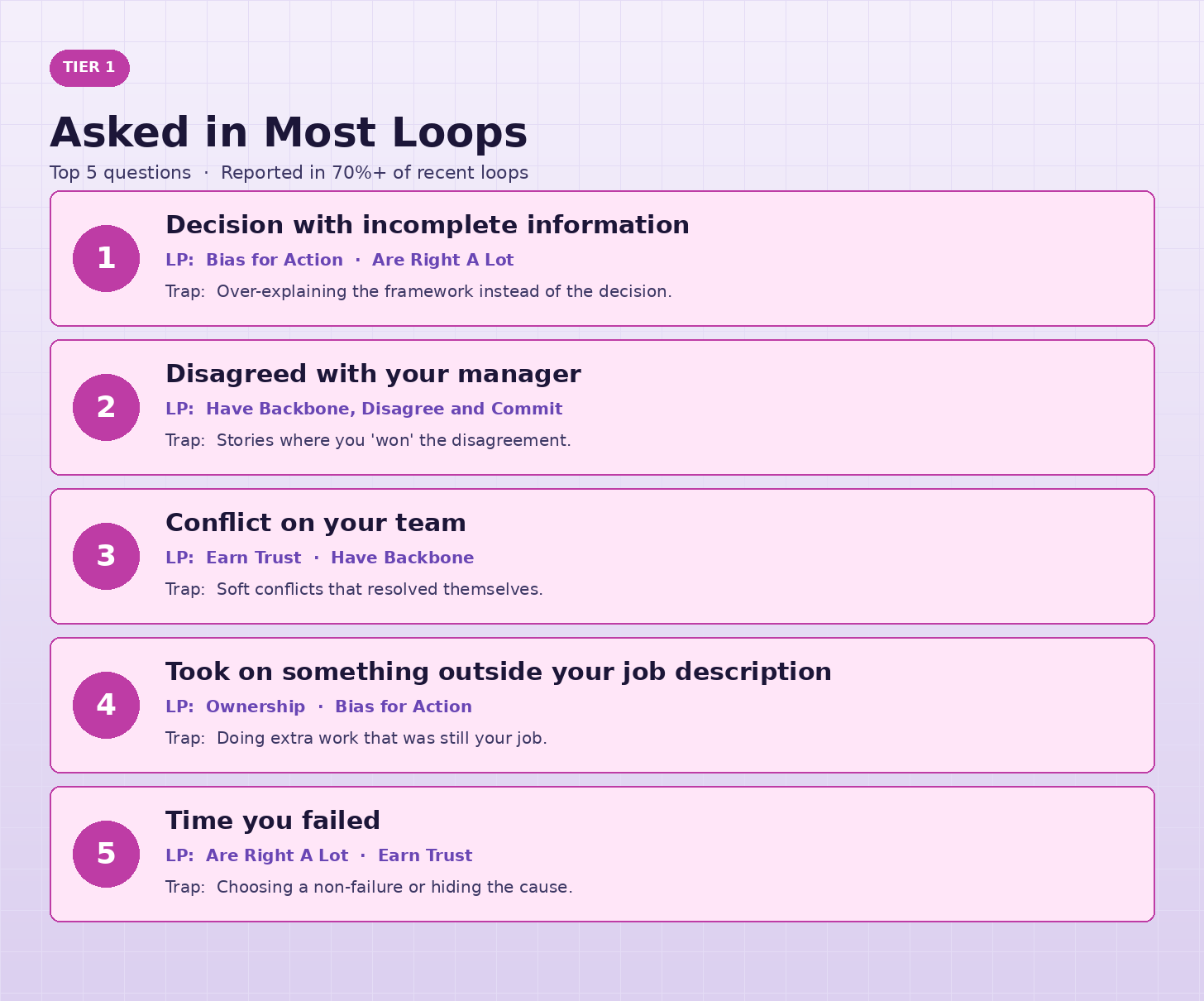
1. “Tell me about a time you had to make a decision with incomplete information.”
Leadership Principles probed: Bias for Action, Are Right A Lot
Why it’s #1: This question is in nearly every Amazon loop because it tests two LPs at once and reveals how the candidate thinks under uncertainty. Both LPs are core to Amazon’s operating culture.
The trap most candidates fall into: Over-explaining the decision-making process. Candidates spend 90 seconds describing the framework they used to evaluate options and 30 seconds on the actual decision and outcome. The interviewer wants the inverse. The decision and the outcome are what’s being graded, not the process diagram.
What scores well: A specific decision you made with limited data, the actual options on the table, what you chose and why, what happened, and what you learned. Bonus points if you acknowledge a follow-up where new data showed your decision was suboptimal and how you adjusted.
What scores poorly: “We” framing throughout. Decisions where you ultimately deferred to someone else. Stories where the “incomplete information” was actually pretty complete and the decision was easy.
Example answer skeleton:
“In Q3 of last year, my team had to choose between two infrastructure migration paths. We had two weeks before a customer SLA renewal and incomplete data on whether path A could meet the latency requirements at our peak load. I made the call to commit to path A despite the data gap, with a contingency to fall back to path B if we hit the SLA boundary in week one. We hit a problem in week two that path B would have avoided, which cost us 3 days. The customer SLA was preserved, but the project was 5 days late. What I learned: when the contingency requires more setup time than I budgeted, the contingency isn’t real.”
2. “Tell me about a time you disagreed with your manager.”
Leadership Principles probed: Have Backbone, Disagree and Commit
Why it’s #1: This is the single most coached and most frequently failed question in the loop. Every candidate prepares an answer. Most prepare the wrong kind.
The trap most candidates fall into: Telling a story where they disagreed and they were right. The interviewer is grading Disagree and Commit, not “Disagree and Win.” A story where the candidate disagreed, lost the argument, and committed fully to the agreed-upon plan is what’s being scored. A story where the candidate disagreed and “convinced” the manager reads as backbone without commit, which is half the LP.
What scores well: A specific instance where you raised a concern, the manager went the other way, you executed the agreed-upon plan without sandbagging, and ideally the outcome later showed the manager was right. The “I was wrong, I committed, here’s what I learned” arc is gold here.
What scores poorly: Hypotheticals. Stories where you “would have” disagreed but didn’t actually push back. Stories where you escalated to the manager’s manager instead of committing to the decision.
3. “Tell me about a time you had to deal with a conflict on your team.”
Leadership Principles probed: Earn Trust, Have Backbone
Why it’s frequent: Amazon teams are deliberately built with high tension. Conflict is expected; how you handle it is what’s graded.
The trap: Soft stories where the conflict was actually a minor disagreement that resolved itself. Or stories where you resolved the conflict by avoiding the person.
What scores well: A real disagreement with a peer or stakeholder, what you specifically did to address it (not what the team did), the resolution, and how the working relationship looked after. Bonus if you stayed in working contact with the person and the trust was higher after the conflict than before.
What scores poorly: “We had a meeting and worked it out.” This is not a story. This is a non-answer.
4. “Tell me about a time you took on something significant outside your job description.”
Leadership Principles probed: Ownership, Bias for Action
Why it’s frequent in 2026: Ownership coverage is now one of the two most-vetoed LP gaps. The Bar Raiser is probing aggressively for Ownership stories, and this question is the most direct probe.
The trap: Stories about doing extra work that was technically still your job. “I stayed late to finish my project” is not Ownership. It’s diligence.
What scores well: A specific instance where you saw a problem that was not assigned to you, picked it up, owned it through to resolution, and the impact was measurable. The story should make clear that no one asked you to do this.
What scores poorly: Volunteering for an assignment your manager handed out. Anything that was rewarded with a promotion or formal recognition (because it implies the work was visible and within scope, which undercuts Ownership).
5. “Tell me about a time you failed.”
Leadership Principles probed: Are Right A Lot, Earn Trust
Why it’s frequent: Universal in interview culture, and Amazon is no exception. The interviewer is grading whether you can articulate failure with specificity and whether you actually learned something.
The trap: Two opposite traps here. First trap: choosing a non-failure (”I worked too hard on a project that succeeded”). Second trap: choosing a real failure but presenting it without ownership (”the project failed because the requirements changed”).
What scores well: A specific failure where you owned the cause, the impact was measurable (and bad), and what you learned changed how you operate. Strong candidates volunteer the failure that hurt most and explain what they do differently now.
What scores poorly: Failures where the candidate wasn’t really at fault. Failures so old that what you learned has compounded into your current default behavior. Failures where the impact was vague.
TIER 2: Asked in Most Onsite Loops (Questions 6-10)
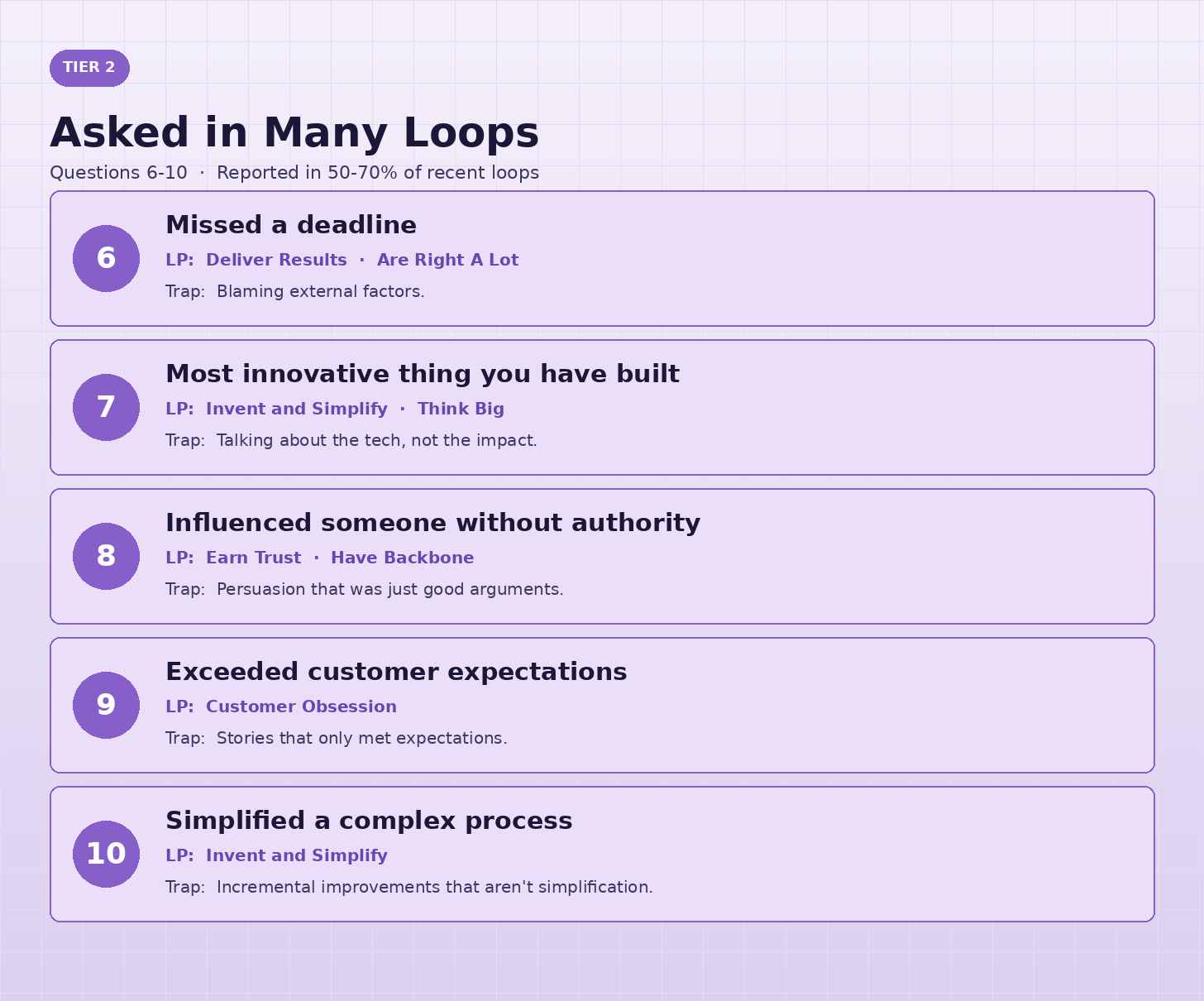
6. “Tell me about a time you missed a deadline.”
LP probed: Deliver Results, Are Right A Lot
The trap: Blaming external factors. The interviewer is grading whether you can own a missed deadline without making it sound like everyone else’s fault.
What scores well: A specific missed deadline, the actual cause (which should include something you did or didn’t do), the customer or business impact, and the system you put in place afterward to catch the problem earlier next time.
7. “Tell me about the most innovative thing you have built or done.”
LP probed: Invent and Simplify, Think Big
The trap: Talking about the technology. The interviewer is grading the customer or business impact of the innovation, not the technical sophistication.
What scores well: Something that solved a real customer problem in a way the team had not done before. The story should make clear what existed before, what you built, and how it changed the outcome.
8. “Tell me about a time you had to influence someone without authority.”
LP probed: Earn Trust, Have Backbone
The trap: Stories where the “influence” was just persuasion through good arguments. The interviewer wants stories where you had to build a case, gather evidence, and bring someone along over time.
What scores well: A specific instance where you needed someone outside your reporting chain to do something, what you did to convince them, and the outcome. Strong stories include specific evidence you gathered and how you presented it.
9. “Tell me about a time you exceeded customer expectations.”
LP probed: Customer Obsession
The trap: “Exceeded expectations” stories that are actually “met expectations.” The bar for this question is high.
What scores well: A measurable customer outcome that surprised the customer (or their team) in a positive way. The customer should have explicitly noted that the result exceeded what they expected.
10. “Tell me about a time you simplified a complex process.”
LP probed: Invent and Simplify
The trap: Stories where the simplification was incremental. The interviewer wants meaningful simplification, not a small efficiency improvement.
What scores well: A specific complex process, what you removed or restructured, and the measurable improvement (time, cost, errors, headcount, whatever).
TIER 3: Asked in Many Onsite Loops (Questions 11-15)
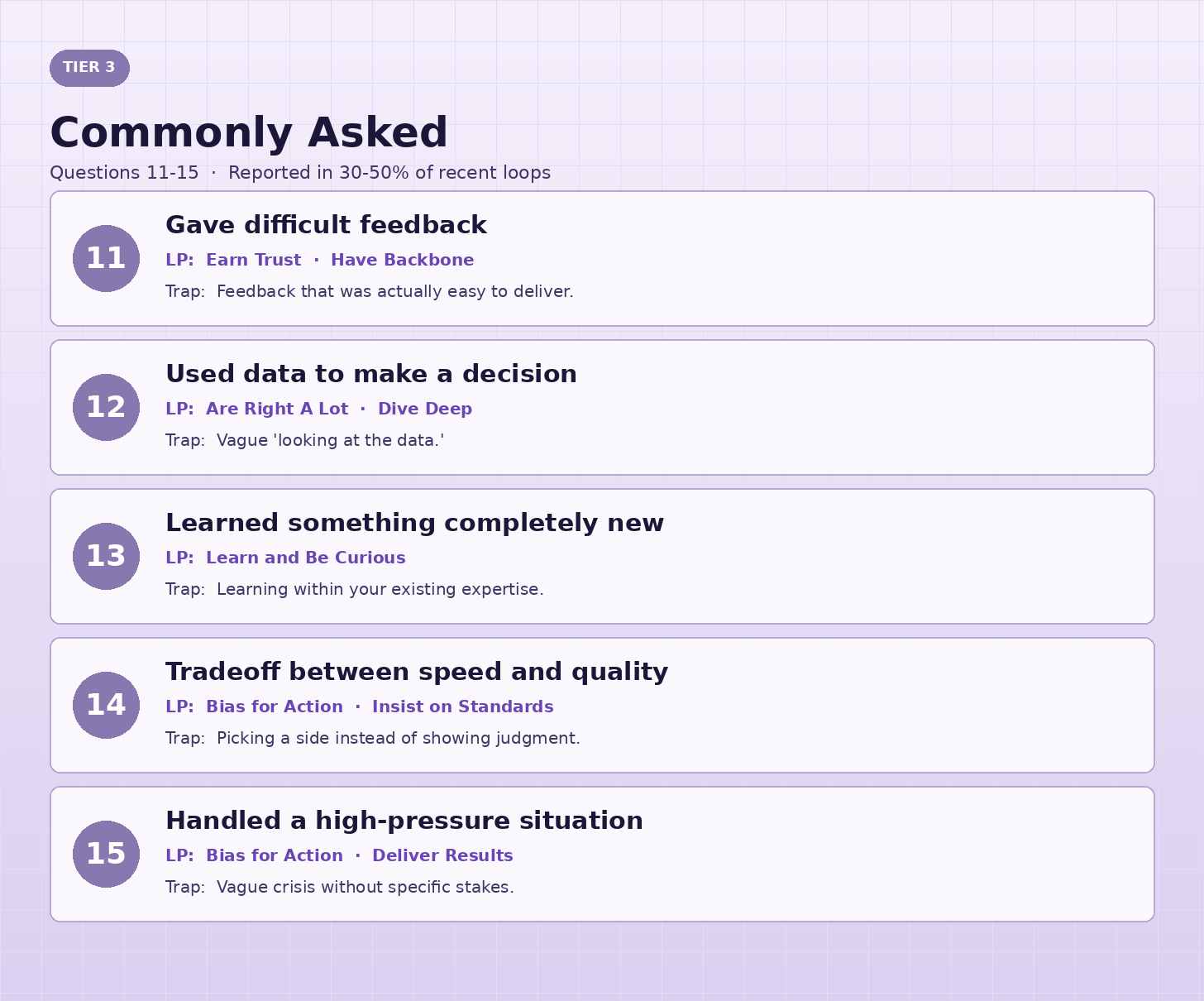
11. “Tell me about a time you had to give difficult feedback to a peer or report.”
LP probed: Earn Trust, Have Backbone
The trap: Stories where the feedback was about a minor issue or where the conversation was easy. Feedback that was “well-received” usually was not actually difficult.
What scores well: A specific instance of feedback that you knew would be hard to deliver, how you delivered it, and what happened to the working relationship afterward. The harder the feedback, the better.
12. “Tell me about a time you used data to make a decision.”
LP probed: Are Right A Lot, Dive Deep
The trap: Vague descriptions of “looking at the data.” The interviewer wants specific data, specific decisions, and specific outcomes.
What scores well: Concrete metrics you analyzed, what the data showed (especially if it surprised you), what you decided based on it, and the outcome.
13. “Tell me about a time you had to learn something completely new on the job.”
LP probed: Learn and Be Curious
The trap: Stories about learning something within your existing area of expertise. The interviewer wants real beginner-mind stories.
What scores well: A specific technology, domain, or skill you knew nothing about, why you needed to learn it, how you went about it, and how proficient you became. Bonus if you mentored others on it later.
14. “Tell me about a time you had to make a tradeoff between speed and quality.”
LP probed: Bias for Action, Insist on the Highest Standards
The trap: Picking a side. The interviewer wants to see judgment, not a default.
What scores well: A specific situation where the tradeoff was real, how you decided which to prioritize and why, the outcome, and what you would do differently. The “I would do it the same way” answer is fine if backed by reasoning.
15. “Tell me about a time you handled a high-pressure situation.”
LP probed: Bias for Action, Deliver Results
The trap: Vague crisis stories. The interviewer wants specific stakes, specific actions, and a specific outcome.
What scores well: A specific high-pressure situation (production incident, customer escalation, deadline crisis), what you did under pressure, the outcome, and what you learned about how you operate when stakes are high.
How to Use This Ranking
Three things to do this week if you have an Amazon loop in the next 60 days.
Audit your story bank against the top 5.
For each of the top 5 questions, do you have a strong, specific story with a measurable outcome and clear ownership?
If you cannot answer all five with confidence, those gaps are your highest-priority prep.
Pressure-test the follow-ups.
For each of your top 5 stories, write down the answers to: “What was the actual number?” “Who specifically was involved?” “What would you do differently?” “What did you learn?”
If you cannot answer all four for any story, that story is not ready.
Use questions 6 through 15 as story-bank coverage testing. These questions probe a wider range of LPs.
If your existing 8-to-10 stories cannot cover them, you have story bank gaps to fill.
The candidates who get offers don’t have better stories. They have stories that survive three layers of follow-up questions.
Build for the follow-ups, not the surface.