
How Long Each FAANG Loop Actually Takes (And What’s Happening in the Gaps)
A complete timeline for each company’s process from first contact to offer, what the silent gaps mean, and how to set realistic expectations for your job search.

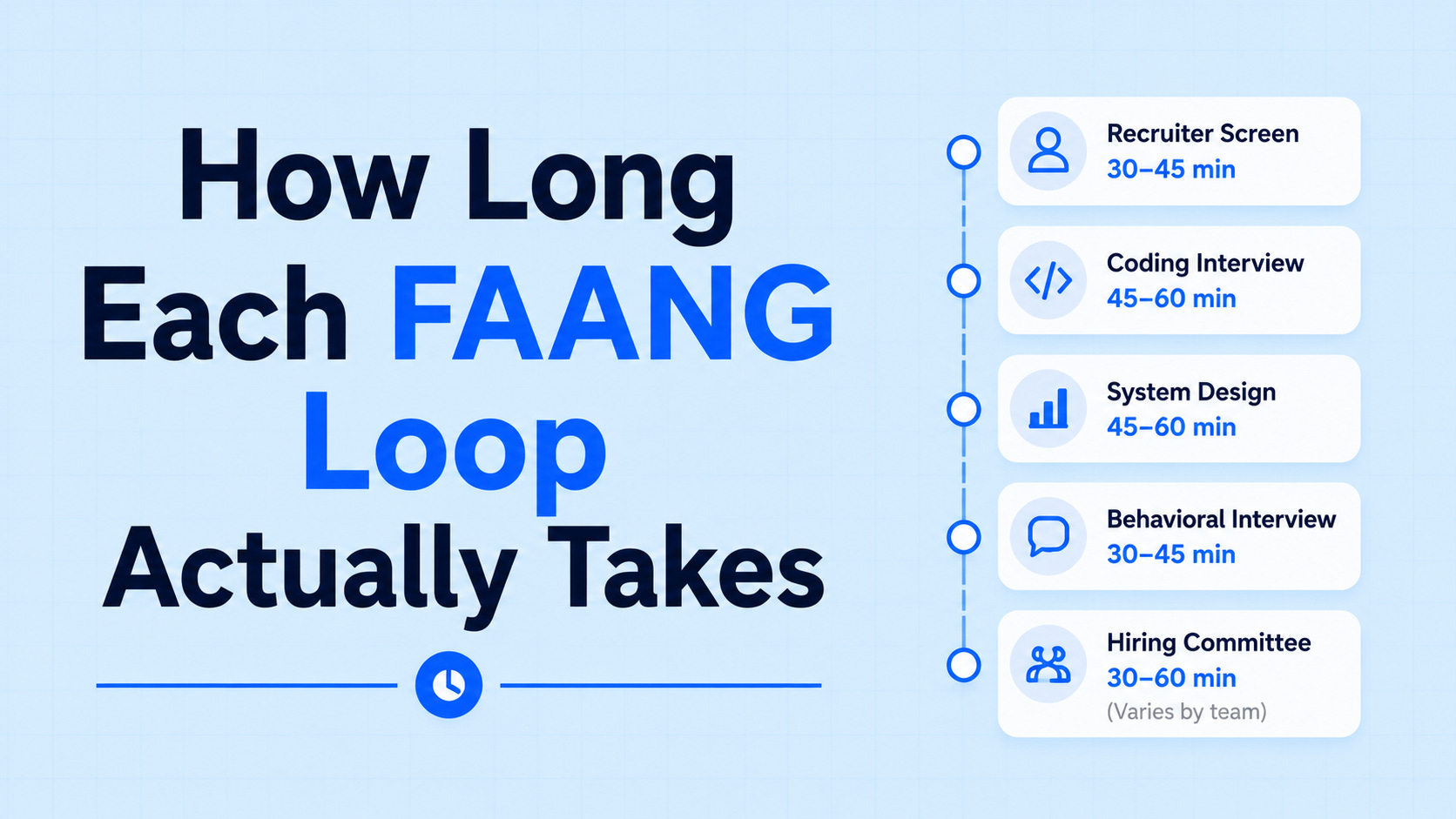
The most stressful part of a FAANG interview process is not the interviews. It is the waiting.
Candidates routinely report multi-week silences between rounds, weeks of no contact after onsite interviews, and uncertainty about whether they should reach out, follow up, or assume they have been rejected.
The silence is rarely communicated by the recruiter in advance, and candidates fill the gap with anxiety.
Most of this silence is structural.
It happens not because anything is wrong with the candidate’s process, but because each FAANG company has a specific internal cadence that determines when packets get reviewed, when committees meet, and when offer decisions get made.
Understanding this cadence is the difference between productive waiting and corrosive anxiety.
This post covers the typical end-to-end timeline at each of the major FAANG companies, what is actually happening during the silent gaps, and what candidates should and should not do during those gaps.
Why Timelines Vary So Much Between Companies
Three structural factors drive differences in timeline length across FAANG companies.
Internal review structure. Companies with centralized hiring committees (Google) take longer than companies with team-based decisions (some Amazon teams). The committee review adds 1 to 3 weeks compared to a team-decision model.
Headcount approval processes. Companies in headcount-constrained periods (which most FAANG companies have been for the past 2 years) require additional approvals after the panel decides. This can add 1 to 2 weeks.
Compensation calibration. Higher-paying companies (Netflix, frontier labs) have more complex compensation review processes. Companies with simpler comp bands (some Amazon and Apple roles) can move faster.
The bottom line: a 6 to 8 week total timeline is typical at most FAANG companies, with significant variation in either direction.
Candidates who expect this in advance experience the process as normal.
Candidates who expect 3 to 4 weeks experience the same process as broken.
The Typical Timeline at Each FAANG Company
Amazon: 4 to 7 weeks total
Week 1: Recruiter reach-out, initial screen.
Week 2: Technical phone screen scheduled and completed.
Week 2-3 (1 week gap): Recruiter waits for phone screen feedback, schedules onsite.
Week 3-4: Onsite loop (5 rounds, typically completed in one day, sometimes split across two).
Week 4-5 (3 to 7 day gap): Debrief meeting. The panel meets, reads notes aloud, votes on Hire/No Hire. The Bar Raiser holds veto power. If unanimous Hire or unanimous No Hire, decision is fast. Mixed votes take longer.
Week 5-6: Offer decision communicated. If offer, comp negotiation begins.
Week 6-7: Final offer signed.
What’s happening in the gaps:
The 1-week gap after phone screen is typically just scheduling. Recruiter is matching your availability with interviewer availability.
The 3 to 7 day gap after onsite is the debrief meeting being scheduled. Bar Raiser availability is often the bottleneck.
Amazon moves relatively fast among FAANG companies because the debrief structure is well-defined and the team has direct say in the decision.
Meta: 5 to 8 weeks total
Week 1: Recruiter reach-out, initial screen.
Week 2: Technical phone screen (or two).
Week 2-3 (1 to 2 week gap): Recruiter schedules onsite, waits for screen feedback.
Week 3-4: Onsite loop (4 to 5 rounds, usually one day).
Week 4-5 (1 to 2 week gap): Hiring committee review. Meta has a hiring committee similar to Google’s, though less formalized.
Week 5-6: Offer decision communicated.
Week 6-8: Compensation negotiation and offer signing.
What’s happening in the gaps:
The gap after onsite at Meta tends to be longer than at Amazon because of the hiring committee review.
The committee meets weekly and reviews multiple candidates per session.
If you are interviewed on a Thursday and the committee meets Tuesdays, you might be reviewed 5 days later.
If you are interviewed on a Wednesday and the committee meets the following Wednesday, you might be reviewed 7 days later. The variance is structural.
Google: 6 to 10 weeks total
Week 1-2: Recruiter reach-out, initial screen, technical phone screen.
Week 3-4: Onsite loop (4 to 5 rounds, sometimes split across two days).
Week 4-6 (1 to 3 week gap): Hiring committee review. Google’s committees are the most structured of any FAANG and review the most thorough packet.
Week 6-7: Team match process (this is a Google-specific step that other FAANG companies do not have). The hiring committee approves you in general; team match places you on a specific team.
Week 7-8: Offer decision and compensation.
Week 8-10: Final negotiation and offer signing.
What’s happening in the gaps:
Google has the most gap-time of any FAANG company, primarily because of two committee-style reviews (hiring committee plus team match).
The team match step is unique. Even after the hiring committee approves the hire, you need to be placed on a specific team.
Some candidates have shorter team match (a team is already waiting for them). Others have longer team match (1 to 4 weeks looking for the right fit).
Candidates often do not understand that being approved by the hiring committee does not automatically mean an offer; team match has to complete first.
Apple: 5 to 9 weeks total
Week 1-2: Recruiter reach-out, initial screen, phone screen.
Week 3-4: Onsite loop (typically 5 to 7 rounds, more rounds than other FAANG companies).
Week 4-6 (2 to 3 week gap): Internal review and approval. Apple’s process is less publicly documented than the others.
Week 6-7: Offer decision.
Week 7-9: Negotiation.
What’s happening in the gaps:
Apple’s process is the most opaque of the FAANG companies.
The 2 to 3 week gap after onsite is consistent with internal panel coordination and team decision-making, but the specifics are less clearly reported than at other companies.
Apple’s interview culture emphasizes confidentiality.
Netflix: 4 to 8 weeks total
Week 1-2: Recruiter reach-out, screening.
Week 2-3: Initial technical conversations (Netflix uses more conversational technical screens than other FAANG).
Week 3-4: Onsite loop (typically 4 to 5 rounds, including several values-focused conversations).
Week 4-5: Decision.
Week 5-8: Compensation. Netflix’s compensation packages are unusually complex (high cash, no traditional stock vesting structure), so negotiation can be longer than at other companies.
What’s happening in the gaps:
Netflix’s earlier rounds are faster than other FAANG. Their compensation negotiation can be longer because Netflix has unusual comp structures and discusses comp specifics more openly than other companies.
What the Silent Gaps Actually Mean
The most common mistake candidates make during the silent gaps is interpreting silence as rejection.
In almost all cases, this is wrong.
A 5 to 10 day gap after onsite at any FAANG company is normal and means nothing about the outcome. It means the debrief is being scheduled or the committee meeting has not yet happened.
A 2 to 3 week gap after onsite at Google or Apple is normal and means nothing about the outcome. It means the committee review process is happening on its standard cadence.
A gap longer than 4 weeks without communication from your recruiter is unusual and warrants a single, professional follow-up email. Recruiters get busy and sometimes need a nudge.
One follow-up is appropriate.
Multiple follow-ups in a short window are not.
What is meaningful: if your recruiter says they will get back to you in 5 days and 10 days pass without contact, that is a small flag worth a follow-up.
If your recruiter has been responsive and your timeline aligns with the standard timelines above, the silence is structural, not personal.
What to Do During the Silent Gaps
Three things to do, and one thing not to do.
Do 1: Keep interviewing elsewhere
The single most stressful pattern is candidates who clear an onsite at one FAANG company and then stop interviewing while they wait for the decision. Three weeks later, they get a rejection, and they are now starting over with no other processes in motion.
The fix: keep interviewing at other companies until you have a signed offer.
The cost of one extra interview is small.
The cost of being out of the market for a month after a rejection is large.
Do 2: Prepare for negotiation in advance
If you have an offer coming, you will have less than a week to negotiate it once it lands.
The negotiation is much easier if you have done the research in advance: market comp data, competing offers, your priorities for the package (cash vs equity vs signing bonus).
Use the silent gaps to do this homework.
Do 3: Stay in light contact with your recruiter
A short message every 1 to 2 weeks to confirm the timeline is appropriate.
“Just checking in on the timeline for the next step. I’m continuing to evaluate other opportunities and wanted to make sure I have an accurate sense of when to expect news.”
This signals you are engaged without seeming desperate.
Do not: Reach out to your interviewers directly
Connecting with people you interviewed with on LinkedIn or sending them thank-you notes after the round is generally fine.
Following up with them about your status, asking them for feedback, or asking them to push for your candidacy is not.
The recruiter manages the process. Going around them creates more friction than it solves.
Setting Realistic Expectations
The single most important thing for a candidate to internalize: the FAANG interview process is not designed for candidate experience. It is designed for hiring quality.
The two are different goals, and the process optimizes for the latter.
This means:
The timeline will be longer than feels reasonable
The communication will be less than feels appropriate
The silence will be more than feels comfortable
None of this means anything about your candidacy. It is structural.
The candidates who handle the process best are the ones who set their expectations against the actual timelines, not the timelines they think the company should have.
If you are early in a process and starting to feel the silence, look at the typical timeline for that company above and recalibrate.
Most likely, the silence is normal.
Most likely, news is coming. Most likely, you are not being ignored.
The interviewer is not the bottleneck.
The committee is not personally avoiding you.
The recruiter is not deliberately stalling.
The process is just slow, and that slowness is the design.