
How to Negotiate Your First FAANG Offer — by Levels, Location, and Competing Offers
A concrete playbook for the most expensive 48 hours of a FAANG offer process. The exact numbers, the actual scripts, and the level-specific tactics that determine whether you leave money on the table.

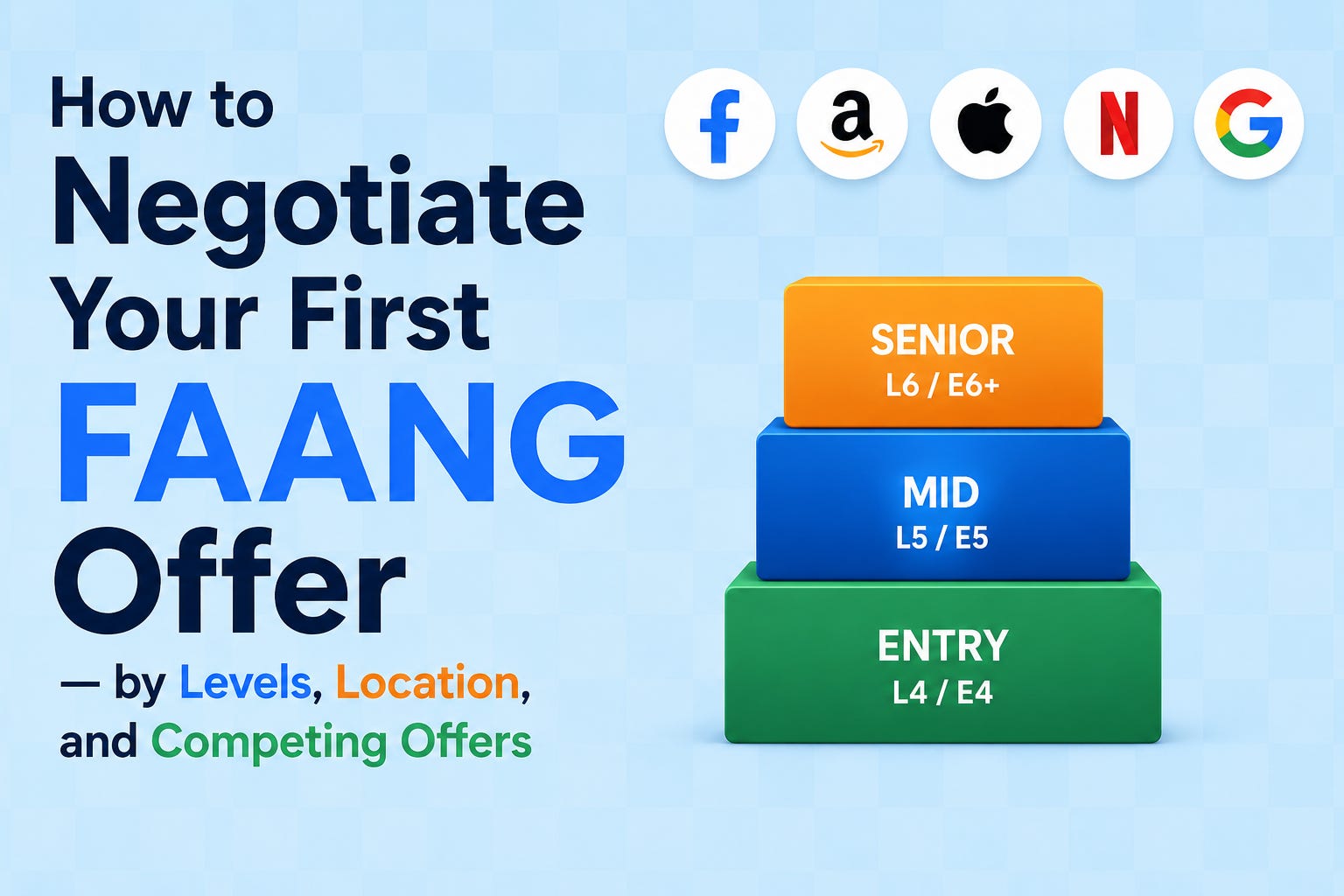
The 48 hours after you receive a verbal FAANG offer are the most financially consequential of the entire hiring process.
Most candidates do not treat them that way.
They spend months preparing for the interviews, and then approach the offer call with no preparation at all. They feel grateful, they thank the recruiter, and they accept the first offer they hear, or accept it with a small ask for a signing bonus.
The cost of this pattern is measurable.
New grads who do not negotiate their FAANG offers typically leave 10,000 to 25,000 USD on the table per year of total compensation.
Mid-career candidates leave 25,000 to 75,000 USD per year.
Senior candidates with competing offers and unused leverage have left 100,000 to 250,000 USD per year on the table. These numbers are not exaggerations. They are what the FAANG comp bands actually look like at the margin where negotiation operates.
This post is the playbook. It assumes you have received or are about to receive a verbal offer from a FAANG company. It covers the specific moves to make, the scripts to use, and the level-specific tactics that determine how much room you actually have.
What Negotiation Actually Negotiates
Before tactics, a precise picture of what is on the table.
FAANG offers are made up of four components that are negotiated differently. Understanding the components is the foundation of every effective negotiation move.
Base salary: The fixed annual cash component. At most FAANG companies in 2026, base salary is the least flexible component. Recruiters have narrow bands they can move within (typically 5 to 15 percent of the band’s midpoint). Pushing hard on base salary often produces small gains.
Annual equity grant: Stock awarded yearly, typically vesting over four years. At most FAANG companies, equity is the most flexible component and the largest portion of senior compensation. Most negotiation gains come from increasing equity grants. Equity is also the component that compounds over time, because equity grant increases now affect every refresh grant in subsequent years.
Signing bonus: A one-time cash payment, typically paid in the first year. Highly flexible. Recruiters can often add or increase signing bonuses with the least internal approval required. This is the component to push on for short-term cash improvements when equity is harder to move.
Relocation, perks, additional benefits: Smaller dollar amounts, but real. Includes relocation packages, sign-on perks like devices or wellness allowances, additional vacation days. Worth asking about, often agreed to without much friction.
The single most important framing shift: do not negotiate base salary first.
Negotiate the equity and signing bonus, where the actual leverage exists.
Most candidates fail at this step because the base salary is the number that feels most concrete and most comparable across offers.
The base is also where the least money is.
The Two-Phase Structure of a FAANG Negotiation
A FAANG negotiation has two distinct phases. Understanding the structure prevents the most common mistake, which is trying to negotiate during the first offer call.
Phase 1: The Offer Call. The recruiter calls or emails to communicate the offer verbally. They read you the numbers. They typically ask whether you have questions and whether you are ready to accept.
This is not the moment to negotiate. It is the moment to receive information.
The correct response to the offer call has one objective: end the call without accepting and without rejecting, with a clear time commitment to a second conversation.
The script that works:
“Thank you for sharing this. I am very excited about the opportunity. I want to take a day or two to review the full package carefully before I give you a complete response. Could we set up a follow-up call later this week to discuss?”
That’s the entire script. You are not negotiating yet. You are buying yourself the time to negotiate properly.
What recruiters expect: candidates who say yes immediately, or who try to start negotiating live on the call. Most recruiters do not have the authority to negotiate on the spot, so live negotiation attempts often end in awkward stalling. The two-call structure makes the negotiation actually work.
Phase 2: The Follow-Up Conversation. This happens 24 to 72 hours after the offer call. You come prepared with specific asks. The recruiter has had time to consult with their hiring manager and compensation team. The actual negotiation happens here.
This is the call where real money moves.
The Three Inputs You Need Before the Follow-Up Call
In the gap between the offer call and the follow-up call, three things determine how much room you actually have.
Input 1: Market data for your level
You need to know what the market range is for your role at your level at this company.
The most reliable source is levels.fyi, which aggregates anonymously-reported compensation data and segments by level, location, and year.
What to look for: the median total compensation for your level and location, the 75th percentile, and the 90th percentile. The median tells you where most offers land. The 75th and 90th tell you where strong negotiations land.
A FAANG offer at the 50th percentile is the standard offer.
A successful negotiation typically moves the offer to the 65th to 80th percentile. Above the 80th is uncommon and requires either strong competing offers or a particularly senior candidate.
You should know these numbers before the follow-up call. Going into negotiation without them is the equivalent of accepting whatever the recruiter says first.
Input 2: Your floor and your target
Before the follow-up call, decide two specific numbers in total compensation.
Your floor is the number below which you walk away.
This number is not for the recruiter. It is for you. It is the number that says “below this, the offer is not worth taking compared to other options I have or will have.”
Your target is the number you would be genuinely excited about. It should be higher than the offer you received but not absurdly so.
A reasonable target for most FAANG negotiations is 15 to 25 percent above the initial offer, with the increase concentrated in equity.
If your target is 25 percent above the initial offer and the recruiter pushes back hard, you have room to settle at 15 percent above.
Without a target, you do not know whether the recruiter’s counter-offer is a real concession or a small adjustment.
Input 3: Real or credible alternatives
The single most powerful negotiation lever in any FAANG offer is the existence of competing offers or credible alternatives.
A “real alternative” is a written offer from another company.
The strongest leverage. Even an offer at a lower-tier company can move FAANG negotiations significantly if the dollar amounts are credible.
A “credible alternative” is a late-stage interview process at another company, with specific timeline data (”I have onsites with Company X and Company Y next week”). This is weaker than a written offer but still meaningful.
The least leverage: no alternatives and no active processes.
In this case, negotiation is still worth doing.
Most FAANG offers have some flexibility regardless but the room is significantly narrower.
If you are negotiating a FAANG offer and you do not have alternatives in motion, the highest-leverage thing you can do is start interviewing at other companies during the negotiation window.
Even a single onsite scheduled at another company materially improves your position.
The Follow-Up Call Script
When the follow-up call starts, here is the structure that works.
Step 1: Acknowledge the offer warmly.
“I really appreciate the offer and I am still very interested in this role. I have taken some time to review the full package carefully, and I wanted to discuss a few specific points.”
Step 2: Name the asks specifically, with reasoning.
“Based on the market data I have reviewed for [level] at [company] in [location], the equity component feels lower than where I would have expected to land. I would also note that I have a competing offer from [company] with a total compensation roughly [X] above this package. Could we discuss whether the equity could move up to [specific number]?”
Notice the structure: market data, competing alternative, specific number. All three together. Each piece reinforces the other.
Without the specific number, the ask is vague.
Without market data, the ask sounds arbitrary. Without the alternative, the ask has no leverage.
Step 3: Stop talking. Let them respond.
The single most common negotiation mistake is filling the silence after your ask. Make the ask, then wait.
The recruiter will respond with one of three things: a counter-offer, a request for time to discuss with the comp team, or a question to better understand your position.
All three are productive responses. Filling the silence prevents them from happening.
Step 4: Anchor on equity, accept smaller wins on base and signing bonus.
The recruiter may come back with smaller equity movement than you asked for, but with offsetting signing bonus or base adjustments.
This is normal.
The annual equity grant is the largest long-term lever, but signing bonuses and base adjustments are real money in the short term.
Take both.
Level-Specific Tactics
The right approach varies by level.
The framework above applies to all levels, but the specifics shift.
New Grad / Entry-Level (L3 / SDE I / E3)
Realistic negotiation range: 5 to 15 percent total compensation increase from initial offer.
What works at this level: Signing bonus pushes are the most successful. Equity grants for new grads are relatively standardized at most FAANG companies, with less flexibility. Signing bonus, however, has significant flexibility because it does not affect the comp band structure.
What does not work: Pushing aggressively on base salary. New grad base salaries have narrow bands.
Script for new grad: “I am very excited about the offer. I have been in discussions with [another company] and they have made a competitive offer. I am hoping to find a way to make this work. Could we increase the signing bonus by [specific number]?”
A 15,000 to 25,000 USD signing bonus increase is realistic for most new grad FAANG negotiations with credible alternatives.
Mid-Level (L4 / SDE II / E4)
Realistic negotiation range: 10 to 20 percent total compensation increase from initial offer.
What works at this level: Annual equity grants.
Mid-level is where equity flexibility really opens up.
A 10 to 20 percent increase in the annual equity grant compounds over the four-year vest, which makes this the most valuable component to push on.
What also works: Targeting specific numbers in market data ranges. At L4, levels.fyi data is rich enough that you can cite specific compensation percentiles meaningfully.
Script for L4: “Based on the levels.fyi data for L4 at this company in [location], the package as offered sits at roughly the 50th percentile. I would expect to land closer to the 70th percentile given my background and the competing offer I am working with. Could we look at increasing the annual equity grant to [specific number]?”
Senior (L5 / SDE III / E5)
Realistic negotiation range: 15 to 30 percent total compensation increase from initial offer.
What works at this level: Equity, signing bonus, and starting-level negotiation. Senior offers have the most flexibility because the comp bands widen significantly and the company has more incentive to close on candidates at this level.
What also works at this level only: Negotiating the level itself. If you have been offered L5 but you believe your scope and experience support L6, this is the level at which you can genuinely have that conversation. (At lower levels, level negotiation rarely works.)
Script for L5: “I would like to discuss two things. First, the equity package — based on market data and my competing offer at Company X, I would expect total compensation closer to [specific number]. Second, given my experience leading [specific scope of work], I would like to understand whether L6 is on the table here. I would love to hear your perspective on both.”
Staff / Principal (L6 / E6 and above)
Realistic negotiation range: 20 to 40 percent total compensation increase from initial offer.
What works at this level: Everything is on the table. Equity, sign-on, base, refresh grant structure, accelerated vesting, performance bonuses. The comp bands are very wide and the company often has significant motivation to close.
What is unique at this level: The conversation can become genuinely consultative rather than transactional. Senior candidates can negotiate not just numbers but structures (acceleration on certain events, additional vesting cliffs, specific performance bonuses tied to outcomes).
Staff and Principal negotiations often require legal review and multiple conversations with the comp team. Plan for the negotiation to take 1 to 2 weeks rather than days.
Location-Specific Adjustments
FAANG compensation varies significantly by location, but the variation is not as large as candidates assume.
Major US hub locations (Bay Area, Seattle, New York): Compensation bands are at or near the top end of the FAANG range.
Secondary US locations (Austin, Boston, Denver): Typically 5 to 15 percent below major hub bands.
Smaller US locations and remote: 10 to 20 percent below major hub bands, though this gap has been narrowing.
International locations (London, Bangalore, Tel Aviv, Dublin): Significantly different comp structures, often with strong local benefits. Comparison to US bands is misleading; compare within the local market.
The key tactical point: if you are negotiating from a non-hub location, do not negotiate against hub-level comp data.
Recruiters know the local bands and will dismiss the comparison. Negotiate against the local market data.
When Competing Offers Actually Move the Needle
Three things determine whether a competing offer creates real leverage.
The competing offer must be specific and verifiable. A vague “I have other offers” does nothing. A specific “I have a written offer from Stripe at 280K total compensation with a decision deadline of next Wednesday” creates real leverage.
The competing company must be credible. A FAANG company will move significantly for a competing offer from another FAANG company or a top-tier engineering employer (Stripe, Databricks, top hedge funds, frontier AI labs). A competing offer from a small startup, even at a higher number, often does not move the needle the same way.
The dollar gap must be reasonable. A competing offer 5 to 15 percent higher than the FAANG offer creates strong leverage. A competing offer 50 percent higher often raises questions about whether the candidate is truly considering the FAANG role.
If you have multiple competing offers, mention all of them by company name in the negotiation. The aggregate creates more leverage than any single one.
Five Mistakes That Cost Money
Mistake 1: Accepting on the offer call. The single most expensive mistake. Always ask for time.
Mistake 2: Anchoring on base salary. The component with the least flexibility. Anchor on equity and signing bonus.
Mistake 3: Vague asks. “Can you do better on this” is not a negotiation. “Could we increase the annual equity grant by 30 shares” is.
Mistake 4: Bluffing competing offers. Recruiters can sometimes verify, and the trust damage from a bluff being caught is permanent. Only reference competing offers that are real.
Mistake 5: Stopping after one ask. Many candidates make one ask, the recruiter agrees, and the negotiation ends. There is often room for additional asks (signing bonus, vacation days, start date). The first concession is the easiest to extract; subsequent ones get harder but are still possible.
What to Do This Week
If you have an active FAANG offer, three actions in order.
Action 1: Pull market data for your level and location from levels.fyi. Write down the 50th, 75th, and 90th percentile total compensation numbers.
Action 2: Decide your floor and target. Write them down. Do not negotiate until you have both numbers.
Action 3: Start at least one additional interview process within 24 hours. Even an onsite scheduled at another company materially shifts your position.
The candidates who get the strongest FAANG offers in 2026 are not the ones who interview best. They are the ones who treat the offer phase with the same preparation they brought to the interview phase.
The 48 hours after the offer call are where the actual compensation gets decided. Prepare for them.