
Inside the Google 2026 Loop: Rounds, Rubric, and What Each Interviewer Scores You On
A complete breakdown of how Google’s engineering interview works in 2026. The four rounds, the hiring committee, the team match step, and what each interviewer is actually grading.

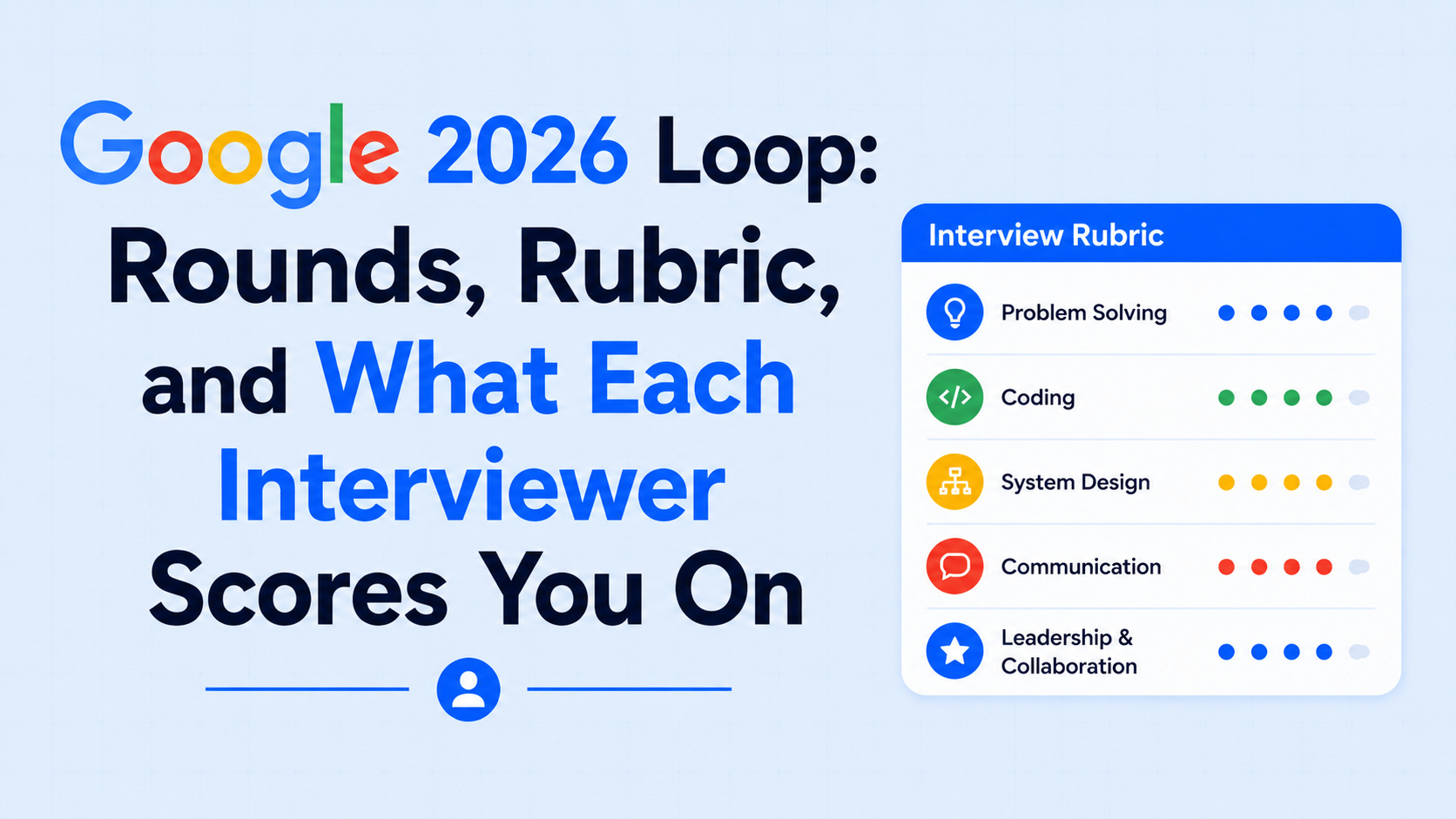
Google’s engineering interview is the most committee-driven of any FAANG company.
This is the structural fact that shapes everything else about the process.
Other FAANG companies make hire decisions at the team level, with varying degrees of additional review.
Google centralizes the decision in a hiring committee that the candidate never meets, never speaks to, and often does not know exists until they have already been processed by it.
The committee reads the written record from the panel and makes the offer call.
This single structural choice means that a Google interview is not really an evaluation that happens in the room. It is the production of a written record that an unseen audience evaluates afterward.
The candidate’s job is not just to perform well during the interview. It is to ensure the interview packet, the document the committee reads, contains the specific evidence the committee needs to approve them at the requested level.
Most candidates do not understand this. They prepare to convince their interviewers. The interviewers are not the audience that decides.
This post breaks down how Google’s loop actually works in 2026: the four standard rounds, the rubric each one is graded against, the hiring committee mechanic, the team match step (which is unique to Google), and what each interviewer is specifically scoring.
What Has Stayed the Same Since 2023
Three things about Google’s loop are essentially unchanged since the last big shift in 2022-2023.
The loop is 4 to 5 rounds for software engineers. Plus a recruiter screen and one or two phone screens before the onsite. The onsite is typically one day, sometimes split across two for senior roles. The total time investment from first contact to offer is 6 to 10 weeks, longer than Amazon or Meta because of the committee review and team match steps.
The hiring committee model. Google has had a centralized hiring committee model since the company was small. The committee reviews packets and makes hire decisions. The committee can override panel “Hire” votes in either direction. (See the dedicated post on the hiring committee mechanic for the full breakdown.)
Googleyness as a real scored dimension. Google evaluates cultural fit through a specific “Googleyness” framework that has remained relatively consistent since the company codified its values. The framework includes intellectual humility, comfort with ambiguity, bias toward collaboration, and ethical grounding. This is graded in nearly every round, though typically without a dedicated round.
These foundations are stable.
What has changed in 2024 and 2025 is what each round actually grades, how the committee reads packets, and what the team match step looks like in a post-layoff Google.
What Changed in 2026
Three shifts that matter to anyone interviewing at Google in 2026.
Shift 1: AI tools are entering coding rounds
Google has signaled it will allow AI tools in coding interviews, following Meta’s shift in late 2025. This is rolling out gradually, not universally.
Some Google loops in 2026 will use the traditional format; some will use the AI-permitted format.
Ask your recruiter explicitly which format your loop uses.
The implications of the AI shift were covered in detail in the Google AI Coding post. The short version: when AI is permitted, the round shifts from “produce correct code from scratch” to “produce correct code by collaborating with an AI tool, and demonstrate engineering judgment about the AI’s output.”
Different skills, different preparation.
Shift 2: The team match step has gotten more selective
Even after the hiring committee approves you, Google places you on a specific team. This step used to be relatively fast: an approved candidate typically had a team within 1 to 2 weeks.
In 2024 and 2025, with hiring more constrained and teams more selective, team match has stretched to 2 to 6 weeks for many candidates. Some approved candidates wait 8+ weeks for team match.
A small number receive committee approval and then sit in team match limbo indefinitely as teams pass.
This means a “Strong Hire” vote from the committee is not yet a job offer. It is a promise that an offer will follow if a team picks you.
The team match step is the new constraint many candidates do not anticipate.
Shift 3: The Googleyness rubric has tightened
Googleyness has always been graded, but the specifics have shifted.
In 2024 through 2026, the framework has been more explicitly tied to candidate behaviors during the interview rather than to candidate statements about themselves.
An interviewer used to read “is this candidate Googley” partly from how the candidate described their values.
Now they read it primarily from how the candidate behaves in the round: how they handle disagreement, how they handle pushback, how they ask for help, how they integrate feedback.
The implication: you cannot prepare for Googleyness by rehearsing answers about Google’s values. You prepare for it by practicing the specific behaviors during technical rounds.
The 4 Rounds, Round by Round
Here is what each round in a 2026 Google software engineering loop actually looks like, what the interviewer is scoring, and the failure modes that quietly tank candidates.
Round 1: Coding (45 minutes)
Format: One algorithmic problem, typically Medium to Medium-Hard difficulty. The candidate clarifies the problem, proposes an approach, codes the solution, walks through edge cases, and articulates complexity.
Standard tool: Google’s internal interview platform or a shared coding environment.
What the interviewer is scoring:
Problem understanding. Did you clarify the problem before coding? Did you ask the right questions?
Pattern recognition. Did you recognize the underlying algorithmic pattern within 1-2 minutes?
Correctness. Does your solution work for the general case and the edge cases?
Complexity articulation. Can you state time and space complexity precisely?
Communication. Are you narrating your thinking, or solving silently?
Googleyness signal. Are you collaborative when the interviewer offers hints, or defensive?
Top failure modes:
Producing optimal code without explaining the brute force baseline first. Google interviewers in 2026 want to see the candidate’s thinking, not just the answer.
Going silent during difficult moments. The packet ends up reading “candidate seemed to be solving but I couldn’t tell how.”
Treating interviewer hints as criticism rather than information. The Googleyness rubric specifically watches for this.
The L4 vs L5 calibration: At L4, you can produce a correct solution with some guidance. At L5, you produce the optimal solution independently.
The interviewer’s notes will reflect which calibration your performance signaled.
Round 2: Coding (45 minutes, often deeper)
Format: A second coding problem, often probing deeper or testing a different pattern than Round 1. The interviewer is typically different.
What is scored differently in Round 2: Google specifically tests for consistency between rounds.
If Round 1 went well, Round 2 is the test of whether that was a good day or a reliable pattern.
If Round 1 went badly, Round 2 is the chance for the candidate to demonstrate that the first round was a fluke rather than a level signal.
Top failure modes:
Underperforming Round 2 because you used your mental energy in Round 1. Google’s panels are aware of this pattern and the committee weights variance heavily.
Producing the same kind of solution structure as Round 1 even if the problem calls for a different approach. This signals pattern-matching to one approach rather than true problem-solving.
Round 3: System Design (45-60 minutes)
Format: Open-ended system design problem.
For L4 candidates, this round has become standard in 2026 (it was less common at L4 in 2022).
For L5 and above, this has always been part of the loop.
What the interviewer is scoring:
Problem framing. Did you ask clarifying questions before drawing?
Component decomposition. Can you break the system into the right components without missing critical ones?
Depth. Can you go three layers deep on at least one important component?
Tradeoff articulation. Can you name concrete tradeoffs with specific numbers, not vague claims?
Production thinking. Did you address failure modes, observability, and operational concerns?
Communication. Are you treating the round as a conversation, not a presentation?
Top failure modes:
Drawing before understanding. Candidates who start placing boxes within 90 seconds signal they have memorized a template and are applying it generically.
Refusing to commit. When asked “would you use SQL or NoSQL,” candidates who say “it depends” without then committing to a specific choice for the specific problem fail this round consistently.
Skipping production thinking. A design that works in the happy path but never addresses how the system handles a failed dependency reads as immature regardless of architectural correctness.
The L4 vs L5 calibration: At L4, scope is given by the interviewer and the candidate is expected to stay within it.
At L5, the candidate is expected to drive the scope conversation.
At L4, two-layers deep on one component is enough. At L5, three or four layers deep on multiple components is expected.
Round 4: Behavioral / Googleyness (45 minutes)
Format: Dedicated behavioral round, typically with the hiring manager or a senior engineer.
The interviewer asks 4 to 5 STAR questions, each tagged to specific behavioral signals.
Follow-up questions probe for specificity and engineering judgment.
Structure of typical questions:
The interviewer asks: “Tell me about a time you had to make a technical decision with incomplete information.”
The candidate gives a 2-to-3-minute STAR answer.
The interviewer follows up: “What was the actual data you had?” “Who else was involved in that decision?” “What would you do differently?”
The follow-ups are where the round is decided. The surface answer establishes the story; the follow-ups establish whether the story holds up to specificity probes.
What is scored:
Specific examples with measurable outcomes. Vague claims of impact are read as weak evidence.
Engineering judgment. Can you articulate why you made the decisions you made?
Collaboration patterns. How did you work with others? How did you handle disagreement?
Learning orientation. What did you take from the experience that changed how you operate?
Googleyness behaviors. Intellectual humility, comfort with ambiguity, ethical grounding.
Top failure modes:
Stories with no measurable outcome. The Googleyness rubric specifically grades for whether candidates think in measurable terms.
“We” stories that obscure the candidate’s specific contribution. The interviewer cannot evaluate Googleyness without knowing what the candidate personally did.
Stories that demonstrate Googleyness through statements (”I value collaboration”) rather than through described behaviors (”I noticed the team disagreement was blocking progress, so I scheduled a 1:1 with each engineer to understand their concerns”).
Round 5 (optional): Additional Coding or Domain-Specific Round
Format: Some Google loops include a fifth round. This can be an additional coding round, a domain-specific round (machine learning, infrastructure, security), or a second system design round for senior candidates.
What is scored: Depends on the round type. Domain-specific rounds test depth in the relevant area. Second coding rounds test consistency further. Second system design rounds test the L5-vs-L6 boundary for senior candidates.
Top failure modes: The same patterns as Rounds 1-3, just in a different context.
What the Interviewer Writes in the Packet
This is the part most candidates do not see, and it is the part the hiring committee reads.
For each round, the interviewer writes:
A summary of what happened in the round. What problem was discussed, what approach the candidate took, how the discussion evolved.
A specific Hire / No-Hire vote at the requested level. The vote scale is typically: Strong Hire, Hire, Leaning Hire, Leaning No-Hire, No-Hire, Strong No-Hire.
Direct quotes from the candidate. What the candidate said about their approach, their reasoning, their decisions.
Specific evidence for the vote. What technical strengths or weaknesses the candidate demonstrated. Specific code or design choices.
Calibration notes. Whether the candidate operated at L4, L5, or L6 depth.
The committee reads this written record without meeting the candidate. They are evaluating the strength of the evidence, not the candidate’s likability or presence.
This is why specific, quotable answers matter so much in a Google interview.
The interviewer cannot write what you did not say.
If you gave a vague answer, the packet will record vague evidence, and the committee will weight it lightly.
The Hiring Committee Decision
After the loop and the packet are complete, the hiring committee reviews.
The committee is 4 to 6 senior engineers from teams other than the one hiring you. They meet typically once a week and review multiple candidates per session.
For each candidate, the committee:
Reads the full packet (typically 30 to 60 minutes of reading per candidate)
Discusses any flagged concerns
Reaches a consensus on Hire / No-Hire at the requested level
May recommend downleveling if the evidence supports a hire at a lower level than requested
The full committee mechanic is covered in depth in the dedicated Hiring Committee post.
The short version: the committee can override panel recommendations in either direction.
Strong panel votes with vague evidence can be overridden. Mixed panel votes with strong specific evidence can be approved.
The Team Match Step
This is the part of the Google process that is unique among FAANG companies, and the part candidates least anticipate.
After the hiring committee approves you, you do not yet have a job offer. You have committee approval. You are now in the team match pool, which means teams within Google who have open headcount review your packet and decide whether to extend an offer.
Team match dynamics:
Some candidates have fast team match. If a team was already waiting for an approved L4 with your specific profile, team match can take a week.
Most candidates have moderate team match. 2 to 6 weeks while teams review profiles.
Some candidates have slow team match. 8+ weeks if no team is actively recruiting your profile.
A small number have unsuccessful team match. Committee-approved but never team-matched. Eventually the approval expires (typically after 6 to 12 months) without an offer.
The team match step has become more constrained in 2024-2026 as Google has slowed hiring overall.
This is structural and not personal; team match length tells you something about Google’s hiring market, not about your candidacy.
The Debrief Mechanics
Unlike Amazon, which has a clearly defined panel debrief meeting, Google’s panel debrief is more distributed. Each interviewer submits their packet independently.
The hiring manager reads all packets and may discuss with individual interviewers if there are calibration questions.
The packets then go to the hiring committee.
This means there is no single moment where the panel “decides” your fate. Each interviewer’s contribution is independent.
The committee then synthesizes.
The implication for candidates: every round matters equally.
There is no “warm-up round” or “low-stakes round” at Google because the committee will read every packet with equal weight.
What This Means for How You Prepare
If you have a Google loop scheduled in the next 60 to 90 days, here is what to do this week, in order of priority.
Prep priority 1: Optimize for the packet, not the room
Most candidates prepare to convince the interviewer in the room.
The interviewer is not the audience that decides.
The hiring committee, who only reads the written record, is.
Practical implication: when you give answers in interviews, optimize for what the interviewer can capture in their notes.
Specific numbers.
Specific quotes.
Specific reasoning.
Vague answers might feel natural in conversation but produce vague notes in the packet.
A useful test: imagine the interviewer is writing notes about your answer as you speak.
Could they capture the specific value you mentioned?
The specific technical choice?
The specific tradeoff?
If not, your answer needs more concrete content.
Prep priority 2: Build consistency across rounds, not excellence in any single round
The committee reads variance as risk.
A candidate with consistent 4-out-of-5 performance across all rounds is more reliably approved than a candidate with one 5-out-of-5 round and one 3-out-of-5 round.
Practical implication: do not spend prep time trying to be exceptional at your strongest area while leaving gaps in your weakest. Closing the floor matters more than raising the ceiling.
Prep priority 3: Practice Googleyness as behavior, not as statements
The Googleyness rubric grades behaviors during the round, not statements about values.
Practice these specific behaviors in mock interviews:
Receiving an interviewer hint and responding constructively (not defensively)
Acknowledging when you don’t know something rather than bluffing
Asking the interviewer for input when you’re stuck
Articulating disagreement with the interviewer respectfully when it’s warranted
These behaviors are what the Googleyness rubric is reading.
Statements like “I value collaboration” are weaker evidence than behaviors that demonstrate collaboration in real time.
Prep priority 4: Understand the team match step before you commit
If you are interviewing at Google, ask your recruiter explicitly about team match in 2026: which teams are actively looking, what the average team match time has been for recent candidates, whether your profile fits multiple teams or just one.
This is information the recruiter has and rarely volunteers.
Candidates who know what to ask get better data, which helps them plan their job search timing.
A Note on Level Calibration
Google’s L4 and L5 distinction is consequential in ways that surprise candidates from other FAANG companies.
At Amazon, an SDE I (L4) and SDE II (L5) interview at similar but different bars.
The difference is real but smaller.
At Google, L4 and L5 interview at meaningfully different bars across every round.
L4 candidates produce correct solutions; L5 candidates produce optimal solutions.
L4 candidates handle scope given to them; L5 candidates drive scope.
L4 candidates demonstrate growth potential; L5 candidates demonstrate established senior-level operation.
Applying at the wrong level is a common mistake.
A candidate applying for L5 with L4-equivalent scope and impact will be downleveled or rejected.
A candidate applying for L4 with L5-equivalent scope and impact will be approved at L4 with the option of “leveling up” after a year or two on a team (which is a slower path than just applying at L5 in the first place).
The recruiter typically calibrates the level before the loop based on resume and screening conversations.
Trust their judgment unless you have specific reason to think they have miscalibrated. Pushing for a higher level than they recommend usually does not end well.
Final Word
Google’s loop is committee-driven, well-defined, and structurally distinct from other FAANG companies.
The path to a clean offer is not just performing well in the room. It is producing the specific written evidence that a committee, which never meets you, needs to approve you at the requested level.
Most candidates do not know the committee exists.
Among those who do, most do not understand that the interview is a packet-production exercise as much as it is a conversation.
Among those who do understand that, most still optimize for the room because the room is where they feel the most pressure.
The candidates who get clean Google offers in 2026 are the ones who hold the committee in their mind throughout the loop.
Every answer is recorded. Every quote becomes evidence.
Every specific number, every articulated tradeoff, every demonstrated behavior is what the committee reads.
The interview is not the test.
The packet is the test.
Optimize for the packet.