
Inside the Meta 2026 Loop: Rounds, Rubric, and What Each Interviewer Scores You On
The full breakdown of Meta’s 2026 engineering loop by level, what each round measures, how the Hire / No Hire rubric works, and which interviewers decide your level.

Here is what this post covers:
The 2026 Meta onsite loop by level
What each round actually measures
The Hire / No Hire scoring mechanic
Which interviewers carry the most weight
The signals that determine your final level
What to do this week
The Meta engineering loop changed more between October 2025 and Q1 2026 than it did in the previous five years.
The number of rounds is different at every level.
The coding format has split into two distinct round types.
The behavioral round now carries enough weight to downlevel a candidate from E5 to E4 on its own. And the rubric most candidates think they are being scored on is not the rubric the hiring committee actually uses.
If you are preparing for a Meta loop in 2026 with an interview prep doc someone shared with you in 2024, you are studying the wrong test.
What follows is the current loop, what each interviewer is scoring, who has the deciding vote, and where the signal traps live.
The 2026 Loop By Level
Meta runs three different loop structures in 2026.
The level you are interviewing for determines which one you sit through.
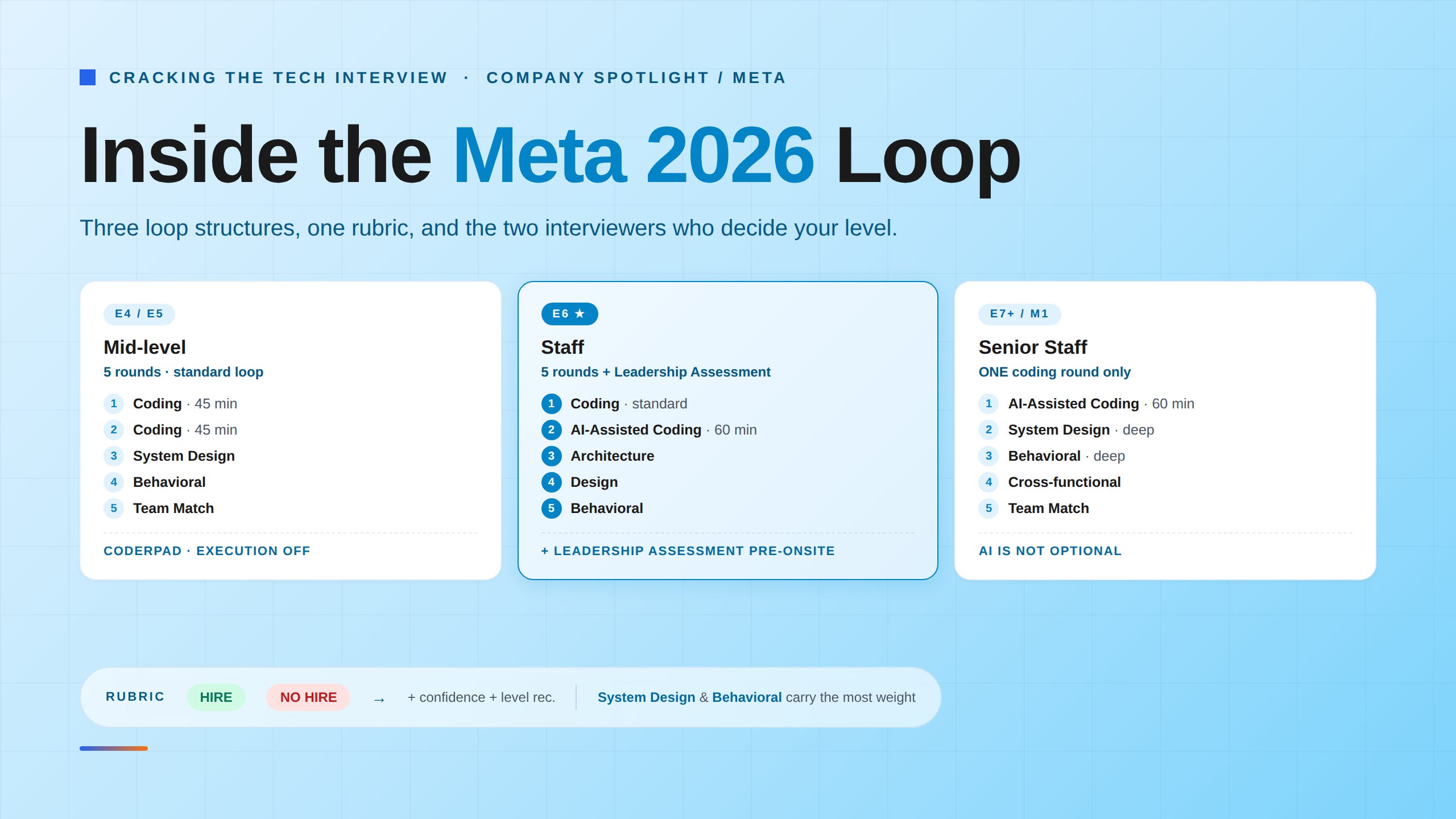
For E4 and E5 candidates, the onsite is five rounds: two coding rounds, one system design or product architecture round, one behavioral round, and one team-matching conversation that is technically not scored but feeds the final decision.
For E6 candidates, the onsite is one standard coding round, one AI-assisted coding round, one architecture round, one design round, and one behavioral round.
There is also a Leadership Assessment interview before the onsite, which replaces the standard phone screen for this level.
The Leadership Assessment is half behavioral and half coding, and it is where the hiring panel decides whether you are likely to make it through the rest of the loop.
For E7 and above, plus M1 manager candidates, the onsite has only one coding round, and it is the AI-assisted version.
There are no two-coding-round loops at the senior bar in 2026. Senior candidates spend the freed time in deeper system design, deeper behavioral, and an additional cross-functional round where they are graded on judgment in ambiguous situations.
The shift to a single AI-assisted coding round for senior candidates is the single biggest structural change in the 2026 loop. It signals what Meta cares about at that level: not whether you can write a sorting algorithm, but whether you can direct work, including AI-generated work, with sound judgment.
The Standard Coding Round
The standard coding round at Meta is 45 minutes.
The interviewer asks two problems. You are expected to finish both.
This is one of the round formats that catches candidates off guard.
Two problems in 45 minutes leaves roughly 20 minutes per problem after introductions and wrap-up.
Candidates who optimize prematurely on the first problem run out of time on the second and walk out with a partial signal.
Meta’s coding round is also famously run with code execution turned off in CoderPad.
You cannot run your code mid-interview. You cannot check your output. You have to mentally execute every line and reason about the result before you commit to it.
The interviewer is scoring four dimensions on this round:
Whether you ask clarifying questions before coding
Whether you produce a working solution at all, and how fast
Whether you can dry-run your code line by line and predict its output
Whether you can self-correct when you spot a bug
That last dimension is where most candidates lose points.
The interviewer is watching for whether you can step through your own code as if reading someone else’s, identify the bug yourself, and fix it without prompting.
This is closely related to the debugging round skill that has become standard across FAANG in 2026.
The verbal scoring is binary: Hire or No Hire.
The interviewer also notes a confidence level in the comments, but only the Hire / No Hire is part of the official record.
The AI-Assisted Coding Round
The AI-assisted round is 60 minutes inside a specialized CoderPad with a chat sidebar.
