
LeetCode Patterns Will Be Confusing Until You Learn This Decision Tree
The Problem-Solving Framework That Helps You Identify the Right Coding Pattern in Minutes Instead of Guessing

Most people learn LeetCode the wrong way.
They collect problem lists.
They solve hundreds of questions.
They watch solution videos.
They memorize patterns.
Yet months later, they still open a new problem and have no idea where to start.
The issue is rarely intelligence.
The issue is recognition.
Interview questions are not difficult because the solutions are hidden. They are difficult because the pattern is hidden.
Experienced candidates see a problem and immediately narrow the possibilities.
Beginners see the same problem and feel overwhelmed.
They ask:
“Should I use a hash map?”
“Is this a sliding window problem?”
“Does this need dynamic programming?”
“Should I use BFS or DFS?”
The confusion comes from trying to choose among too many options at once.
Strong candidates do something different. They use a decision tree.
Instead of asking:
“What pattern is this?”
They ask a sequence of smaller questions.
Each question eliminates possibilities.
Eventually only one or two patterns remain.
The process becomes predictable.
And once it becomes predictable, interview preparation becomes much easier.
Master Leetcode questions using our pattern-based approach; check Grokking the Coding Interview.
Why LeetCode Feels Random at First
Imagine learning a new language.
Someone gives you a dictionary containing fifty thousand words.
Technically, everything you need is there.
Practically, you still cannot speak.
Many candidates approach LeetCode the same way.
They learn:
Two Pointers
Sliding Window
Binary Search
BFS
DFS
Backtracking
Dynamic Programming
Heaps
Tries
Graph Algorithms
Individually, each pattern makes sense.
The problem appears when you face a new question.
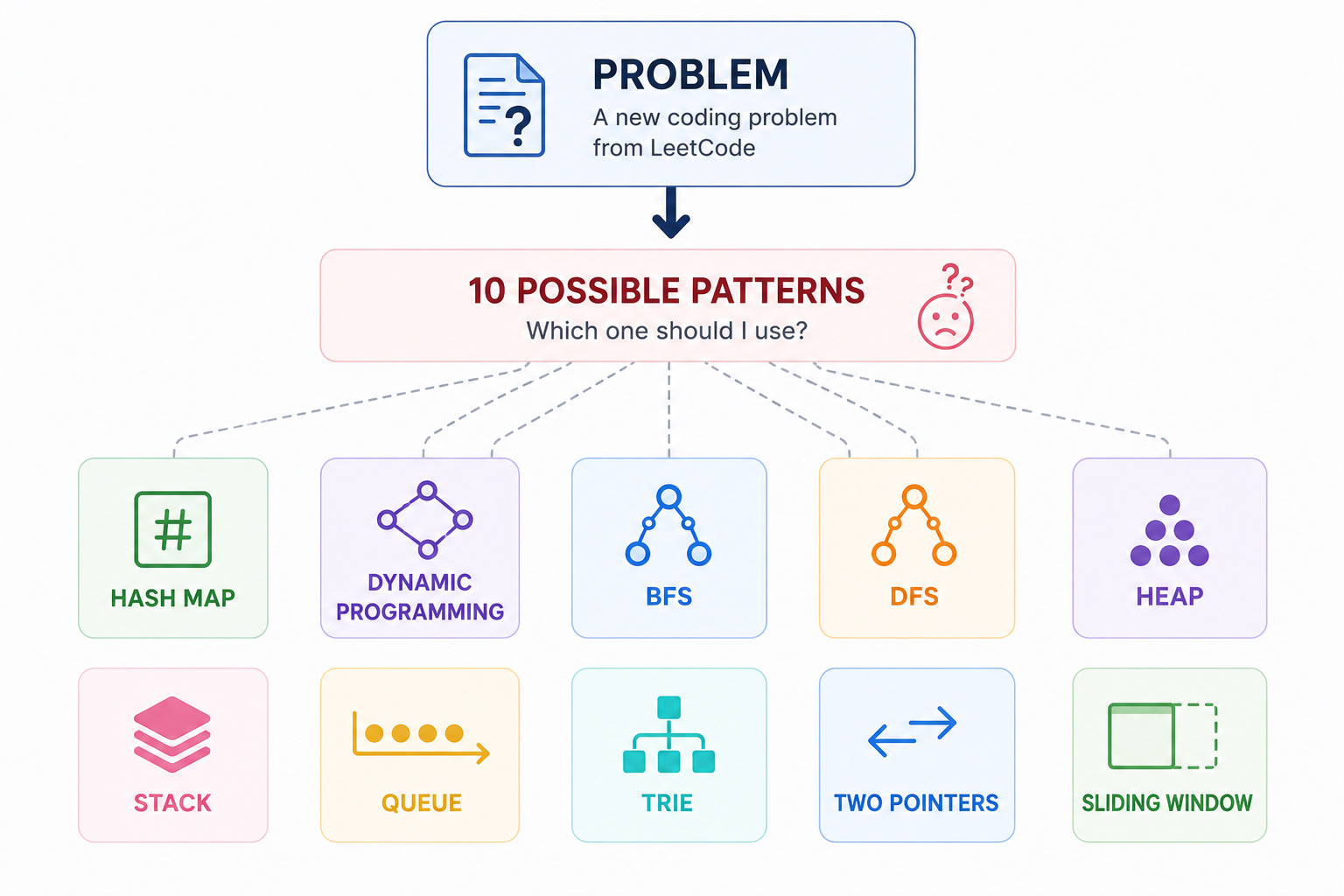
You know ten patterns.
The interviewer gives you one problem.
Which pattern should you use?
This is where most candidates freeze.
The missing piece is not another pattern.
The missing piece is a selection process.
The Real Skill Is Pattern Recognition
Interview preparation is often described as problem solving.
That is only partially true.
A large percentage of coding interviews involve pattern recognition.
The strongest candidates quickly identify:
What kind of data is present
What kind of operation is required
What constraints exist
Which patterns fit those constraints
They are not guessing.
They are following a mental framework.
Think of it like a doctor diagnosing symptoms.
A doctor does not randomly choose treatments.
They ask questions.
Each answer narrows the possibilities.
Coding interviews work similarly.
The Decision Tree Mindset
When reading a problem, do not ask:
“What is the solution?”
Ask:
“What category does this belong to?”
That single change dramatically reduces complexity.
Instead of solving immediately, classify first.
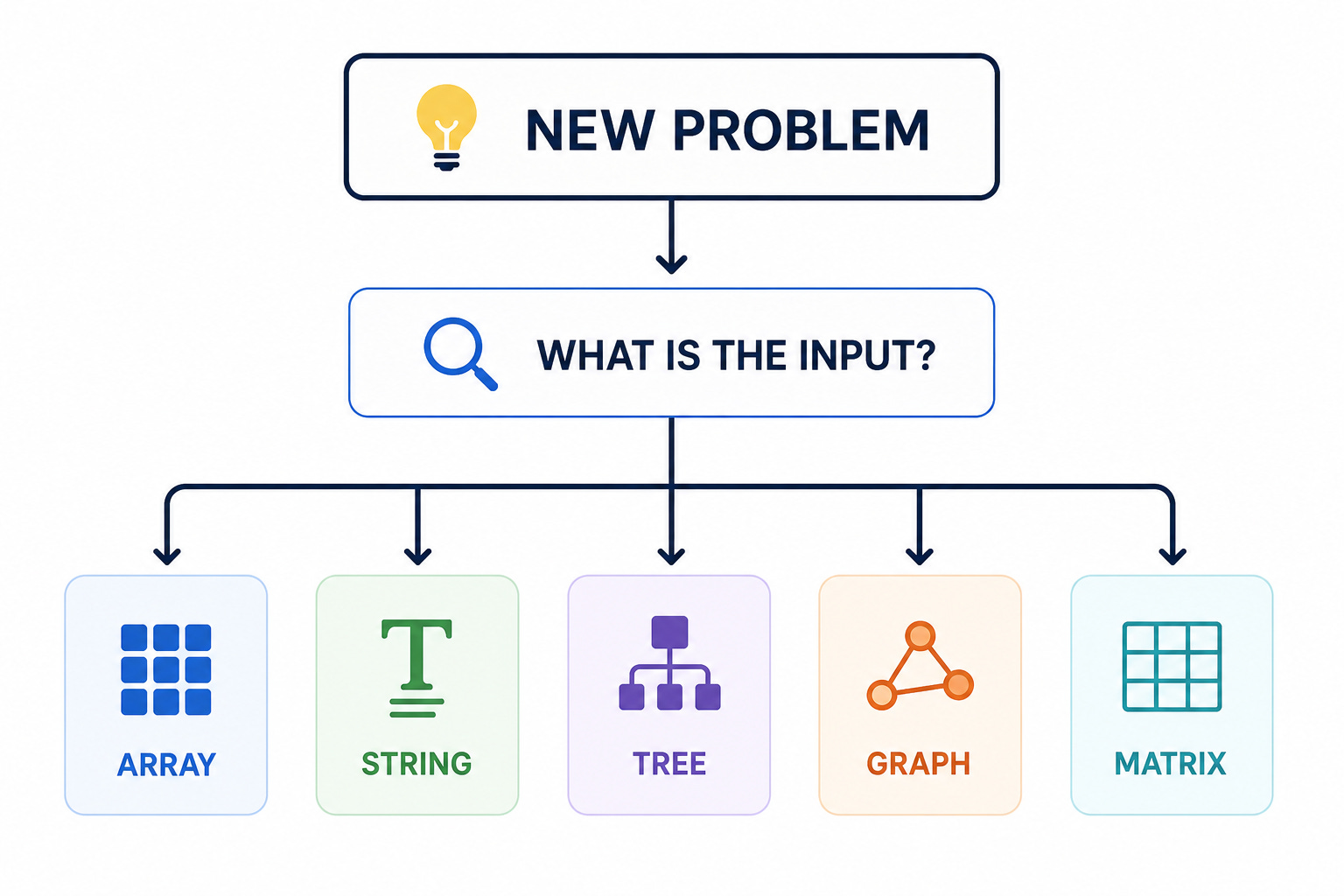
A useful decision tree starts with the input.
Question #1: What Is the Input?
The input often provides the biggest clue.
Ask yourself:
Is the data:
An array?
A string?
A linked list?
A tree?
A graph?
A matrix?
This sounds obvious.
It is not.
Many candidates ignore the input structure.
Yet the structure frequently eliminates most patterns immediately.
For example:
If the problem involves a binary tree, sliding window is unlikely.
If the problem involves a graph, two pointers are unlikely.
If the problem involves a linked list, graph algorithms are usually irrelevant.
The input immediately narrows the search space.
Arrays and Strings: The Most Common Branch
Most interview questions begin here.
Arrays and strings dominate coding interviews.
When you see one, ask the next question.
Question #2: Are We Looking for a Pair, Triplet, or Relationship Between Elements?
Examples:
Two Sum
Three Sum
Container With Most Water
If the answer is yes, think about:
Two Pointers
Hash Maps
These patterns appear repeatedly.
Hash Map Signals
Look for:
Fast lookup
Frequency counting
Duplicate detection
Complement values
Examples include:
Two Sum
Group Anagrams
Top K Frequent Elements
Whenever repeated lookup becomes expensive, a hash map is often the answer.
Two Pointer Signals
Look for:
Sorted arrays
Opposite ends
Pair relationships
Triplets
Examples include:
Two Sum II
Three Sum
Container With Most Water
The key question becomes:
Can two moving indices replace nested loops?
If yes, think two pointers.
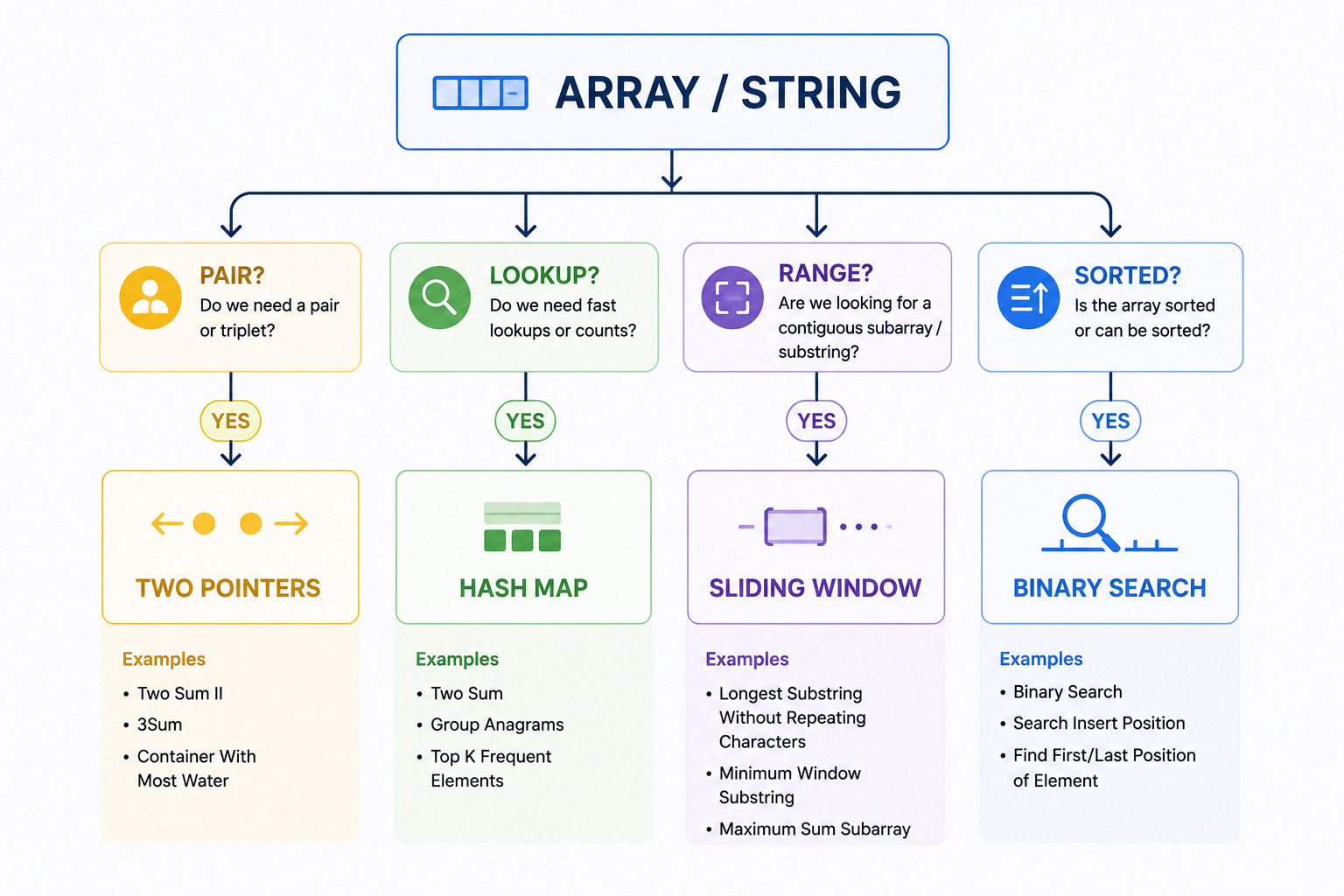
Question #3: Is This About a Contiguous Subarray or Substring?
This question is incredibly important.
When candidates miss it, they often miss the pattern entirely.
Words like:
Longest
Shortest
Maximum
Minimum
Combined with:
Subarray
Substring
Consecutive
Often point toward one pattern.
Sliding Window.
Sliding Window Signals
Examples:
Longest Substring Without Repeating Characters
Minimum Window Substring
Maximum Sum Subarray
Ask yourself:
Can I maintain a moving range rather than recomputing everything?
If yes, sliding window becomes a strong candidate.
This pattern alone solves a surprisingly large percentage of interview questions.
Question #4: Is the Array Sorted?
A sorted array is a giant hint.
Interviewers rarely provide sorted data without a reason.
The first pattern to consider is:
Binary Search.
Many candidates only associate binary search with finding a value.
That is too narrow.
Modern interviews use binary search in several ways.
Traditional Binary Search
Find an element.
Find insertion position.
Find boundaries.
Examples:
Search Insert Position
First Bad Version
Binary Search on the Answer
This variation confuses many candidates.
The value being searched does not exist directly in the array.
Instead, you search a range of possible answers.
Examples:
Koko Eating Bananas
Capacity to Ship Packages
When you see:
“Find the minimum possible value.”
or
“Find the maximum feasible value.”
Binary search should enter your mind.
Question #5: Does the Problem Involve Hierarchy?
Hierarchy usually means:
Trees.
Whenever nodes have parent-child relationships, tree patterns become likely.
Now the decision tree continues.
Tree Questions: The Next Branch
When you see a tree, ask:
Am I exploring depth or levels?
This distinction often determines the solution.
DFS Signals
Use DFS when you care about:
Paths
Recursive structure
Subtrees
Depth calculations
Common DFS questions:
Maximum Depth
Path Sum
Diameter of Binary Tree
DFS feels natural because trees are recursive.
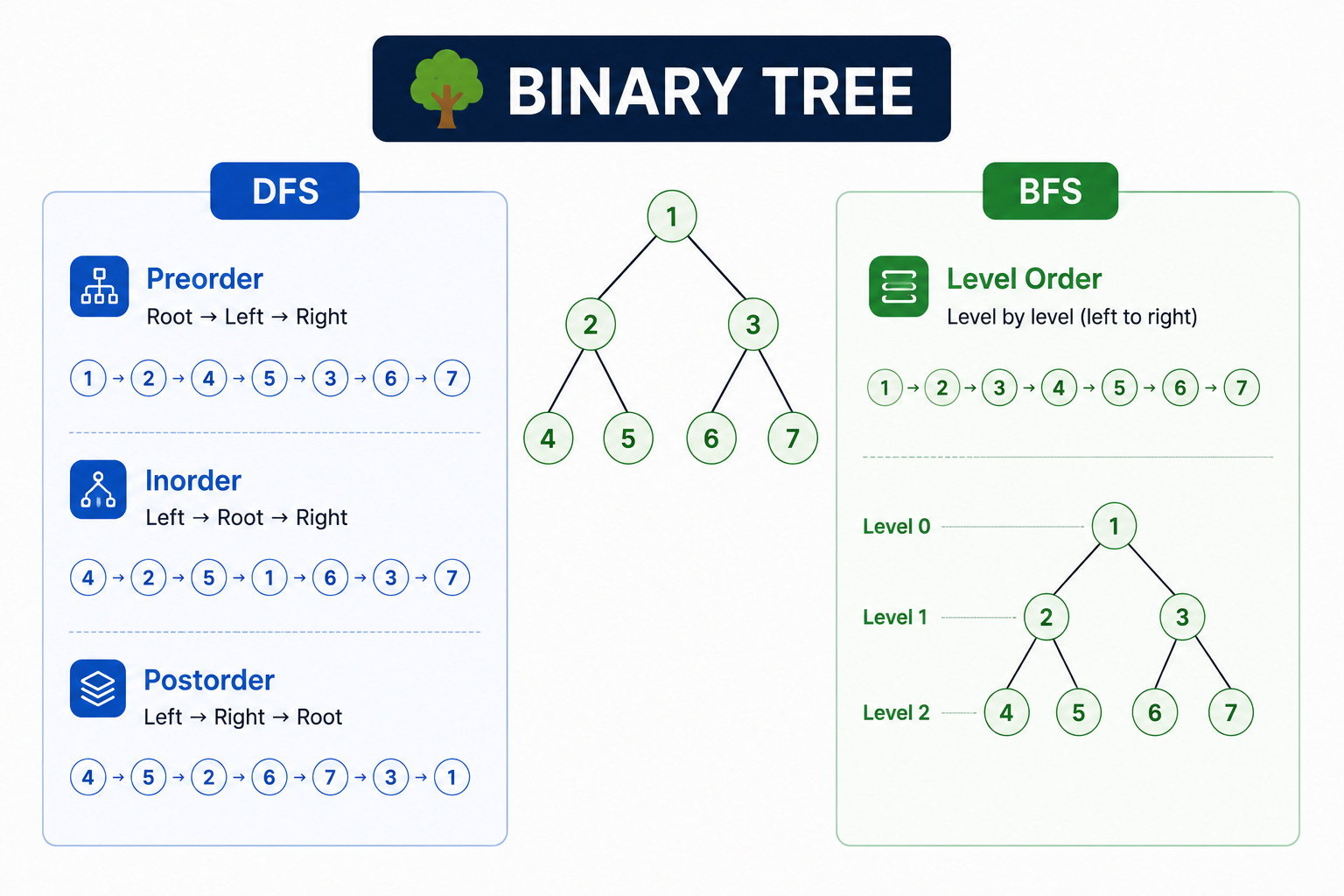
BFS Signals
Use BFS when you care about:
Levels
Shortest paths
Layer-by-layer traversal
Common BFS questions:
Binary Tree Level Order Traversal
Minimum Depth
A useful shortcut:
Level → BFS
Path → DFS
It is not always correct.
But it is often a useful starting point.
Question #6: Can We Make a Choice at Every Step?
Now we enter one of the most confusing categories.
Backtracking.
Many candidates struggle because they fail to recognize its signals.
Backtracking problems often involve:
Generating combinations
Generating permutations
Exploring possibilities
Constraint satisfaction
Examples:
Subsets
Permutations
N-Queens
The key clue is branching.
At each step, you choose.
Then choose again.
Then choose again.
The solution explores a decision tree.
If that sounds familiar, backtracking should be on your radar.
Question #7: Are We Recomputing the Same Work?
This is where Dynamic Programming begins.
Unfortunately, DP is often taught badly.
Candidates memorize solutions instead of recognizing the pattern.
The first clue is repeated work.
Ask:
Am I solving the same subproblem multiple times?
If yes, DP becomes a possibility.
Examples:
Climbing Stairs
Coin Change
Longest Increasing Subsequence
But do not jump into DP immediately.
Many candidates force DP onto problems that have simpler solutions.
DP should usually be a last resort.
Not a first guess.
Why Most Candidates Struggle With Dynamic Programming
The problem is not coding.
The problem is identification.
Most candidates never ask the three questions that matter.
What is the subproblem?
What is the recurrence?
What are the base cases?
Without answers, DP feels impossible.
With answers, DP becomes much more manageable.
Question #8: Are We Processing Things by Priority?
Now consider heaps.
Heaps are another pattern candidates often miss.
Look for phrases such as:
Top K
Largest K
Smallest K
Most Frequent
Closest Points
These problems usually involve ranking.
Whenever ranking appears, think about heaps.
Examples:
Top K Frequent Elements
K Closest Points to Origin
Find Median From Data Stream
The moment you see “top K,” a heap should be one of the first patterns you consider.
Why Pattern Recognition Beats Memorization
Candidates often ask:
“How many LeetCode problems should I solve?”
The wrong question.
The better question is:
“How quickly can I identify the pattern?”
Someone who solved 500 problems through memorization often struggles with unfamiliar variations.
Someone who solved 150 problems and learned pattern recognition frequently performs better.
Interviewers rarely care whether you have seen the exact question before.
They care whether you can recognize structure.
That structure comes from decision trees.
Not memorization.
The Goal Is to Eliminate Possibilities
One mistake candidates make is searching for the correct answer immediately.
Instead, eliminate incorrect answers.
Suppose you see:
An array
Sorted input
Need minimum feasible value
Suddenly:
BFS disappears
DFS disappears
Sliding Window becomes unlikely
Backtracking becomes unlikely
Binary Search becomes much more likely.
The problem becomes easier because the search space shrinks.
This is how strong candidates think.
The Moment Everything Starts Making Sense
Eventually something interesting happens.
You stop seeing individual questions.
You start seeing categories.
You stop seeing:
“Longest Substring Without Repeating Characters.”
You see:
“Sliding Window.”
You stop seeing:
“K Closest Points.”
You see:
“Heap.”
You stop seeing:
“Number of Islands.”
You see:
“Graph Traversal.”
That transition changes everything.
Interview preparation becomes less about memory.
It becomes more about recognition.
And recognition is the real skill behind coding interviews.
The Complete Decision Tree Starts With Elimination
Most candidates try to identify the right pattern immediately.
Strong candidates eliminate the wrong patterns first.
That sounds like a small distinction.
It is not.
Imagine a multiple-choice exam.
Finding the correct answer among ten options is difficult.
Eliminating eight wrong answers makes the problem much easier.
Pattern recognition works the same way.
The goal is not:
“What’s the solution?”
The goal is:
“What category can this possibly belong to?”
Every answer narrows the search space.
Eventually only one or two patterns remain.
The Graph Branch
Graphs are where many candidates get intimidated.
The good news is that most graph interview questions are actually variations of a few core ideas.
When you see:
Cities
Flights
Courses
Connections
Networks
Dependencies
Relationships
You should immediately consider graphs.
Now ask the next question.
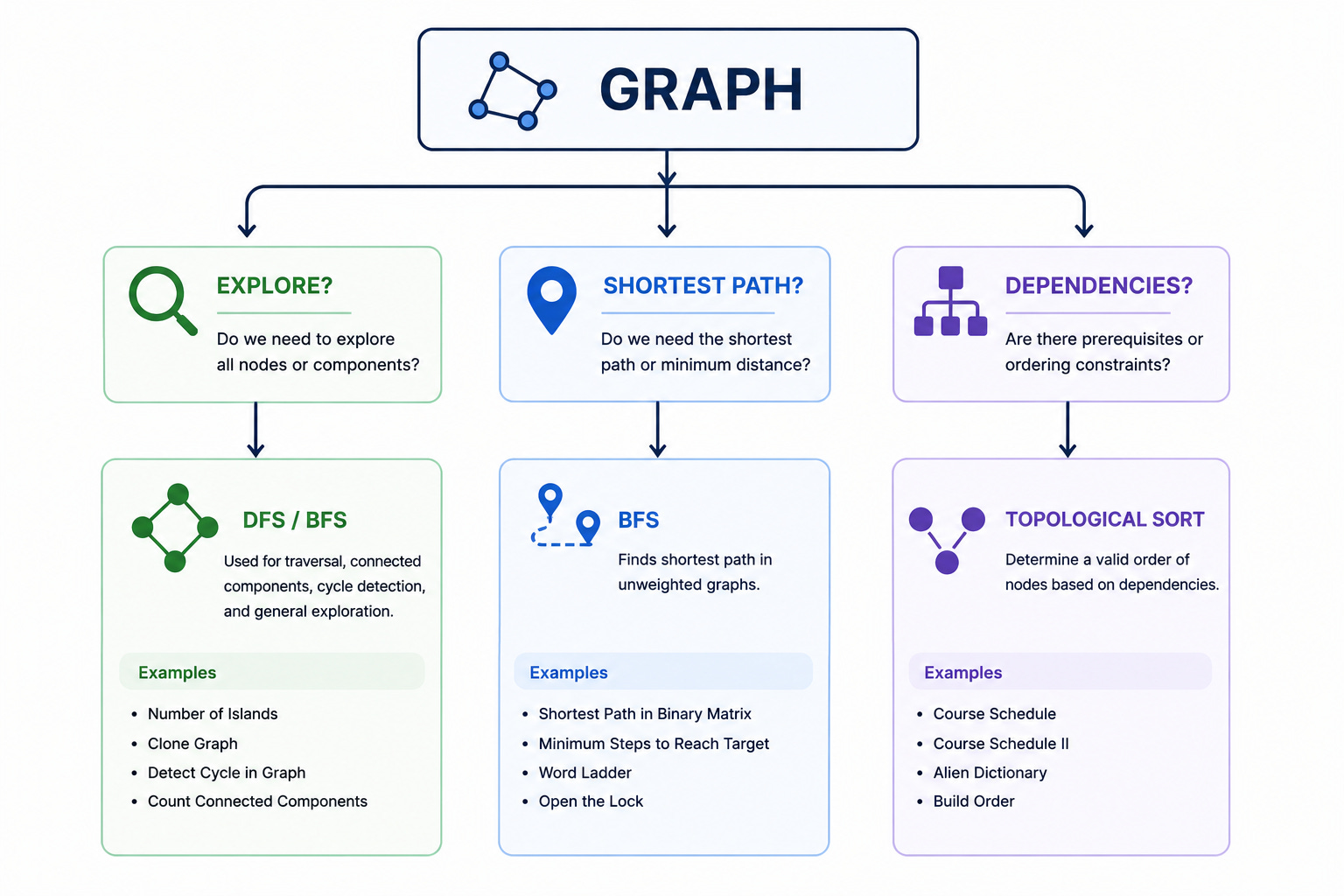
Question #9: Do We Need to Explore Everything or Find the Shortest Path?
This single question solves a huge percentage of graph problems.
Explore Everything
Think:
Connected components
Reachability
Island counting
Examples:
Number of Islands
Clone Graph
Connected Components
The most common patterns become:
DFS
BFS
Either can work in many cases.
Shortest Path
The moment shortest path appears, your thinking changes.
Examples:
Minimum number of moves
Shortest route
Minimum distance
Now BFS becomes much more attractive.
Particularly when all edges have equal weight.
A useful shortcut:
Unweighted shortest path → BFS
Many interview questions follow this pattern.
Question #10: Are There Dependencies?
Dependencies are another giant clue.
Examples:
Course prerequisites
Build systems
Task scheduling
These questions often involve:
Topological Sort.
Candidates frequently miss this pattern because they focus on the story instead of the structure.
The story may involve courses.
Or projects.
Or jobs.
Or workflows.
The underlying problem is dependency ordering.
Whenever something must happen before something else, think about topological sorting.
Question #11: Are We Revisiting Nodes?
This question often determines whether you need a visited set.
Many graph bugs come from cycles.
Candidates understand BFS.
Candidates understand DFS.
Yet they forget cycle detection.
The result is infinite traversal.
Strong candidates automatically ask:
Can this graph contain cycles?
If yes, they immediately think about visited tracking.
This habit prevents many interview mistakes.
The Matrix Branch
Matrices appear constantly in interviews.
Many candidates think they are a separate category.
Usually they are not.
Most matrix questions are secretly graph problems.
Consider:
Number of Islands
Rotting Oranges
Pacific Atlantic Water Flow
The matrix is simply a graph represented differently.
Each cell becomes a node.
Neighbors become edges.
Once candidates recognize this, many matrix questions become much easier.
The Interval Branch
Intervals deserve their own category because they appear frequently.
Common clues include:
Meeting times
Schedules
Ranges
Time periods
Overlapping segments
The key question becomes:
Question #12: Do Intervals Overlap?
If yes, interval patterns become likely.
Examples:
Merge Intervals
Meeting Rooms
Insert Interval
Most interval questions revolve around:
Sorting
Comparing neighboring ranges
Merging overlaps
Once you recognize overlap as the core concept, many interval questions feel very similar.
The Heap Branch
Many candidates learn heaps.
Few recognize them quickly.
The decision tree helps.
Ask:
Question #13: Do I Need the Best K Elements?
Words such as:
Top
Largest
Smallest
Closest
Most Frequent
Are enormous clues.
Examples:
Top K Frequent Elements
K Closest Points
Kth Largest Element
The moment you see ranking, think heap.
This recognition alone can save several minutes during interviews.
The Monotonic Stack Branch
This pattern confuses many candidates because it appears less frequently.
The good news is that it has very recognizable signals.
Ask:
Question #14: Am I Looking for the Next Greater or Smaller Element?
Examples:
Next Greater Element
Daily Temperatures
Largest Rectangle in Histogram
These problems often involve:
“Find the next thing that satisfies a condition.”
Without a monotonic stack, solutions often become O(n²).
With the correct pattern, they become O(n).
Strong candidates immediately recognize these signals.
The Dynamic Programming Branch
This is where the decision tree becomes most valuable.
Most DP problems feel unrelated.
Climbing Stairs looks different from Coin Change.
Coin Change looks different from House Robber.
House Robber looks different from Longest Increasing Subsequence.
Yet they share common signals.
Question #15: Does the Current Decision Affect Future Decisions?
This is often the first DP clue.
Examples:
Should I rob this house?
Should I take this coin?
Should I include this item?
Should I use this character?
The decision today affects future possibilities.
That dependency is a major signal.
Question #16: Are We Solving the Same Subproblem Repeatedly?
This is the classic DP question.
If the same state appears repeatedly, memoization may help.
Examples:
f(5)
 ├ f(4)
 ├ f(3)

f(4)
 ├ f(3)
 ├ f(2)
Notice something.
f(3) appears multiple times.
Repeated work is the heart of dynamic programming.
The Three Questions That Unlock DP
Most candidates overcomplicate DP.
The strongest candidates simplify it.
Every DP problem begins with three questions.
Question 1: What Is the State?
Examples:
Position.
Index.
Amount remaining.
Current house.
Current node.
The state describes what remains to be solved.
Question 2: What Is the Decision?
Examples:
Take.
Skip.
Move left.
Move right.
Choose coin.
Ignore coin.
Most DP problems become easier once the decision is obvious.
Question 3: What Are the Base Cases?
Eventually recursion stops.
Those stopping conditions are the base cases.
Many DP bugs come from incorrect base cases.
Strong candidates pay attention to them early.
The Most Common Pattern Confusion
Many candidates struggle because multiple patterns appear possible.
That is normal.
In fact, it is often a good sign.
Let’s examine common confusion points.
Sliding Window vs Two Pointers
Ask:
Are we maintaining a range?
If yes:
Sliding Window.
Are two independent indices moving toward a goal?
If yes:
Two Pointers.
DFS vs BFS
Ask:
Do I care about levels?
If yes:
BFS.
Do I care about paths or recursive exploration?
If yes:
DFS.
Heap vs Sorting
Ask:
Do I need everything sorted?
If yes:
Sorting.
Do I only need the best K items?
If yes:
Heap.
Backtracking vs DP
Ask:
Am I exploring all possibilities?
If yes:
Backtracking.
Am I repeatedly solving the same state?
If yes:
DP.
These small questions eliminate enormous confusion.
What Strong Candidates Actually Do
Many people imagine strong candidates instantly know the answer.
Usually they don’t.
What they do have is a process.
When facing an unfamiliar problem, they follow a sequence.
Step 1
Identify the input.
Step 2
Identify the operation.
Step 3
Identify constraints.
Step 4
Match signals to patterns.
Step 5
Test a candidate pattern.
This process feels systematic.
Because it is.
The Biggest Mistake: Looking for Exact Matches
Many candidates search their memory.
“This looks like a problem I’ve seen before.”
Sometimes that works.
Often it doesn’t.
Interviewers intentionally modify familiar questions.
They change constraints.
They introduce twists.
They alter requirements.
Candidates who rely on memory struggle.
Candidates who rely on recognition adapt.
That distinction matters.
Why Solving More Problems Stops Helping
Many candidates reach a plateau.
They solve:
100 problems.
Then 200.
Then 300.
Yet interview performance barely improves.
Why?
Because they are collecting solutions.
Not building a recognition framework.
Without a decision tree, every new question feels new.
With a decision tree, many questions start looking familiar.
That familiarity dramatically reduces cognitive load.
Building Your Own Decision Tree
The best decision tree is the one you build yourself.
After every problem, ask:
What clues identified the pattern?
What words pointed me toward the solution?
What eliminated other patterns?
Write these observations down.
Over time, a personalized framework emerges.
This is how strong interview candidates think.
Not because they memorized hundreds of answers.
Because they learned how to classify problems efficiently.
The Goal Is Faster Recognition
Most interview failures are not coding failures.
They are recognition failures.
Candidates spend twenty minutes searching for the right approach.
Then solve the problem quickly once they find it.
The bottleneck was never implementation.
It was identification.
Decision trees solve this problem.
They create a repeatable process.
They reduce uncertainty.
They make unfamiliar problems feel familiar.
And that is often the difference between struggling through LeetCode and finally feeling like the patterns make sense.
The Complete LeetCode Decision Tree
By now, you’ve seen how strong candidates identify patterns.
Let’s put everything together into one framework.
When you encounter a new problem, walk through these questions.
What is the input?

├── Array / String
│
│   ├── Pair or Triplet?
│   │      → Two Pointers / Hash Map
│   │
│   ├── Contiguous Range?
│   │      → Sliding Window
│   │
│   ├── Sorted?
│   │      → Binary Search
│   │
│   ├── Top K?
│   │      → Heap
│   │
│   └── Overlapping Ranges?
│          → Intervals
│
├── Linked List
│
│   ├── Cycle?
│   │      → Fast & Slow Pointers
│   │
│   ├── Reverse?
│   │      → Pointer Manipulation
│   │
│   └── Merge?
│          → Two Pointers
│
├── Tree
│
│   ├── Levels?
│   │      → BFS
│   │
│   └── Paths / Structure?
│          → DFS
│
├── Graph
│
│   ├── Explore?
│   │      → DFS / BFS
│   │
│   ├── Shortest Path?
│   │      → BFS / Dijkstra
│   │
│   └── Dependencies?
│          → Topological Sort
│
└── Choices + Repeated Work?
       → Dynamic Programming
This is not perfect.
No decision tree is.
But it dramatically reduces confusion.
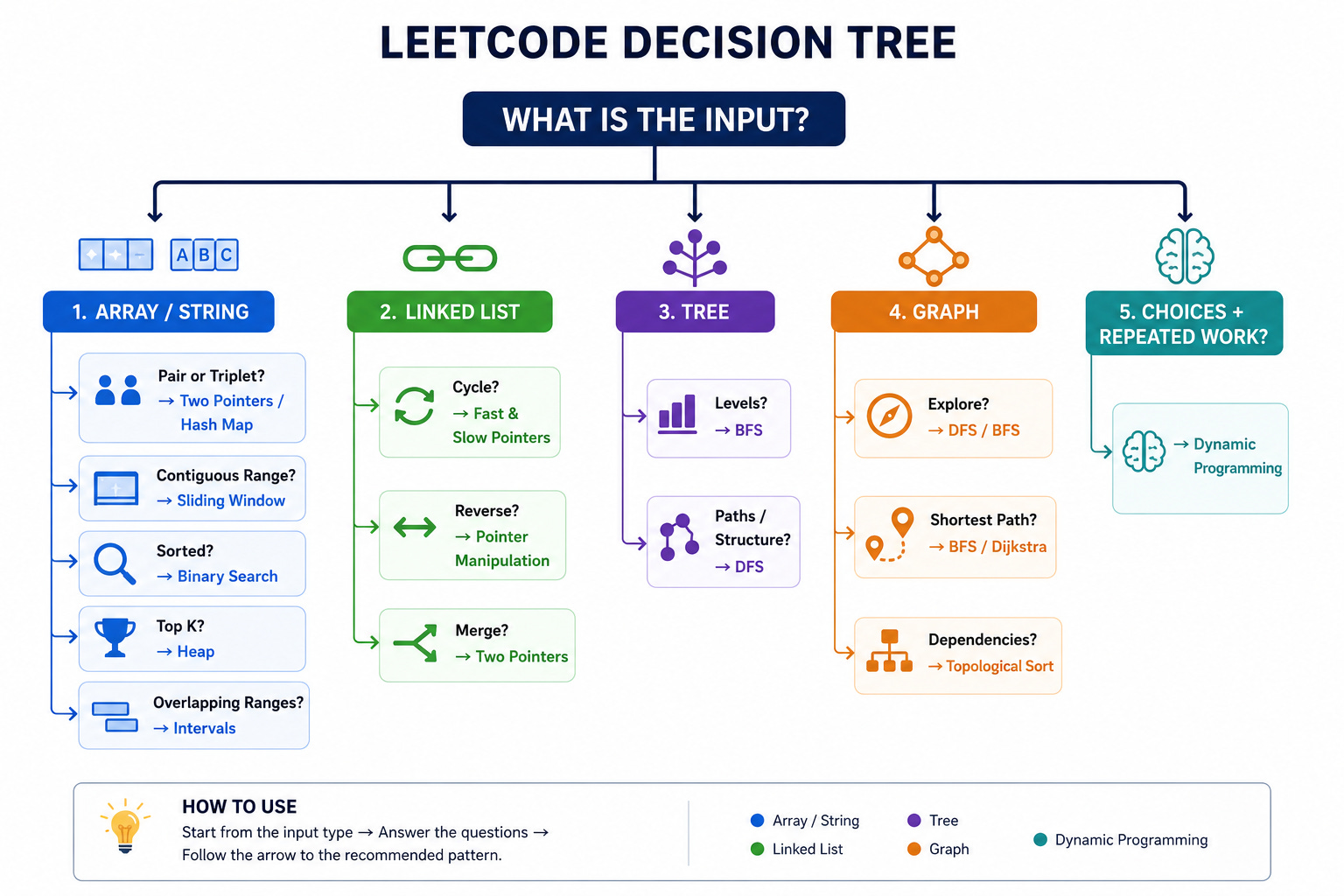
Instead of ten possible patterns, you usually end up with one or two.
That makes the interview much easier.
How Strong Candidates Read Problems
Most candidates read problems looking for solutions.
Strong candidates read problems looking for clues.
This distinction matters.
Consider the following problem statement.
“Find the longest substring without repeating characters.”
Many candidates immediately start brainstorming algorithms.
Strong candidates notice two clues.
First:
“Substring”
Second:
“Longest”
Those two words immediately point toward a contiguous range problem.
Contiguous ranges frequently lead to Sliding Window.
The pattern appears before the solution.
This is how recognition works.
Walkthrough #1: Longest Substring Without Repeating Characters
Let’s run it through the decision tree.
Input?
String.
Looking for a pair?
No.
Looking for a contiguous range?
Yes.
Substring.
Looking for longest or shortest?
Yes.
Longest.
That combination strongly suggests Sliding Window.
The solution becomes much easier to find because the search space is already small.
Walkthrough #2: Two Sum
Let’s apply the framework again.
Input?
Array.
Looking for a relationship between elements?
Yes.
Need two numbers.
Possible patterns:
Two Pointers
Hash Map
Is the array sorted?
No.
That removes Two Pointers.
Hash Map becomes the strongest candidate.
Notice how the decision tree guided the process naturally.
Walkthrough #3: Number of Islands
This question intimidates many candidates.
But let’s use the framework.
Input?
Grid.
What is a grid?
Usually a graph.
Each cell connects to neighboring cells.
Need shortest path?
No.
Need exploration?
Yes.
We must discover connected regions.
Possible patterns:
DFS
BFS
The problem suddenly becomes much less mysterious.
Walkthrough #4: K Closest Points to Origin
Input?
Array.
Need a pair?
No.
Need a contiguous range?
No.
Need the best K elements?
Yes.
That immediately points toward Heap.
Strong candidates often recognize this within seconds.
Not because they memorized the problem.
Because they recognized the signal.
Walkthrough #5: Course Schedule
Many candidates initially think:
Graph.
Which is correct.
But we can go deeper.
Input?
Relationships.
Dependencies.
Need shortest path?
No.
Need ordering?
Yes.
Some tasks must happen before others.
That is a dependency problem.
Dependency problems often lead to:
Topological Sort.
Again, the pattern emerges from the clues.
The Three Most Valuable Recognition Signals
After coaching candidates and analyzing hundreds of interview questions, three signals appear repeatedly.
Signal #1: Longest, Shortest, Maximum, Minimum
These words matter.
They frequently indicate:
Sliding Window
Dynamic Programming
Binary Search
Whenever optimization appears, pay attention.
The pattern is often hiding nearby.
Signal #2: Top K
This is one of the strongest clues in coding interviews.
Examples:
Top K Frequent Elements
K Closest Points
K Largest Numbers
Whenever you see Top K, think:
Heap.
Not always.
But very often.
Signal #3: Choices
Choices frequently signal:
Backtracking
Dynamic Programming
Examples:
Should I take this?
Should I skip this?
Should I move left?
Should I move right?
The moment choices influence future decisions, DP becomes a possibility.
Why Interviewers Like Pattern Recognition
Interviewers are not trying to see whether you memorized solutions. They want to know whether you can identify structure.
Real engineering works the same way. You rarely encounter identical problems.
Instead, you encounter familiar patterns.
A caching issue resembles another caching issue.
A scaling problem resembles another scaling problem.
An indexing problem resembles another indexing problem.
The engineer who recognizes patterns moves faster.
Interview questions test that ability.
How to Build Pattern Recognition Faster
Many candidates improve slowly because they solve problems incorrectly.
After finishing a question, they move on.
That is a missed opportunity.
The most valuable learning happens afterward.
Ask yourself:
Why was this Sliding Window?
Why wasn’t it Two Pointers?
Why was this BFS?
Why wasn’t it DFS?
Why was this Heap?
Why wasn’t it Sorting?
These comparisons build recognition.
Recognition builds speed.
Speed improves interview performance.
The Pattern Journal
One of the most effective interview-prep habits is maintaining a pattern journal.
After every problem, write:
Problem:
Pattern:
Signals:
Alternative patterns considered:
Mistakes made:
Example:
Problem:
Longest Substring Without Repeating Characters

Pattern:
Sliding Window

Signals:
Substring
Longest
Contiguous range

Alternatives:
Hash Map

Mistake:
Forgot shrinking condition
This process accelerates learning dramatically.
Over time, the signals become obvious.
Why Most LeetCode Roadmaps Feel Overwhelming
Many roadmaps contain:
300 problems
20 categories
Dozens of subcategories
Candidates assume they need to memorize everything.
That creates anxiety.
The reality is simpler.
Most interview questions come from a surprisingly small set of patterns.
The challenge is not learning fifty patterns.
The challenge is identifying the correct one quickly.
That is why decision trees matter so much.
The 80/20 Rule of Coding Interviews
A relatively small number of patterns appear repeatedly.
For most candidates, these patterns provide the highest return:
Tier 1
Hash Map
Two Pointers
Sliding Window
Binary Search
DFS
BFS
Tier 2
Heap
Backtracking
Dynamic Programming
Intervals
Tier 3
Monotonic Stack
Trie
Union Find
Advanced Graph Algorithms
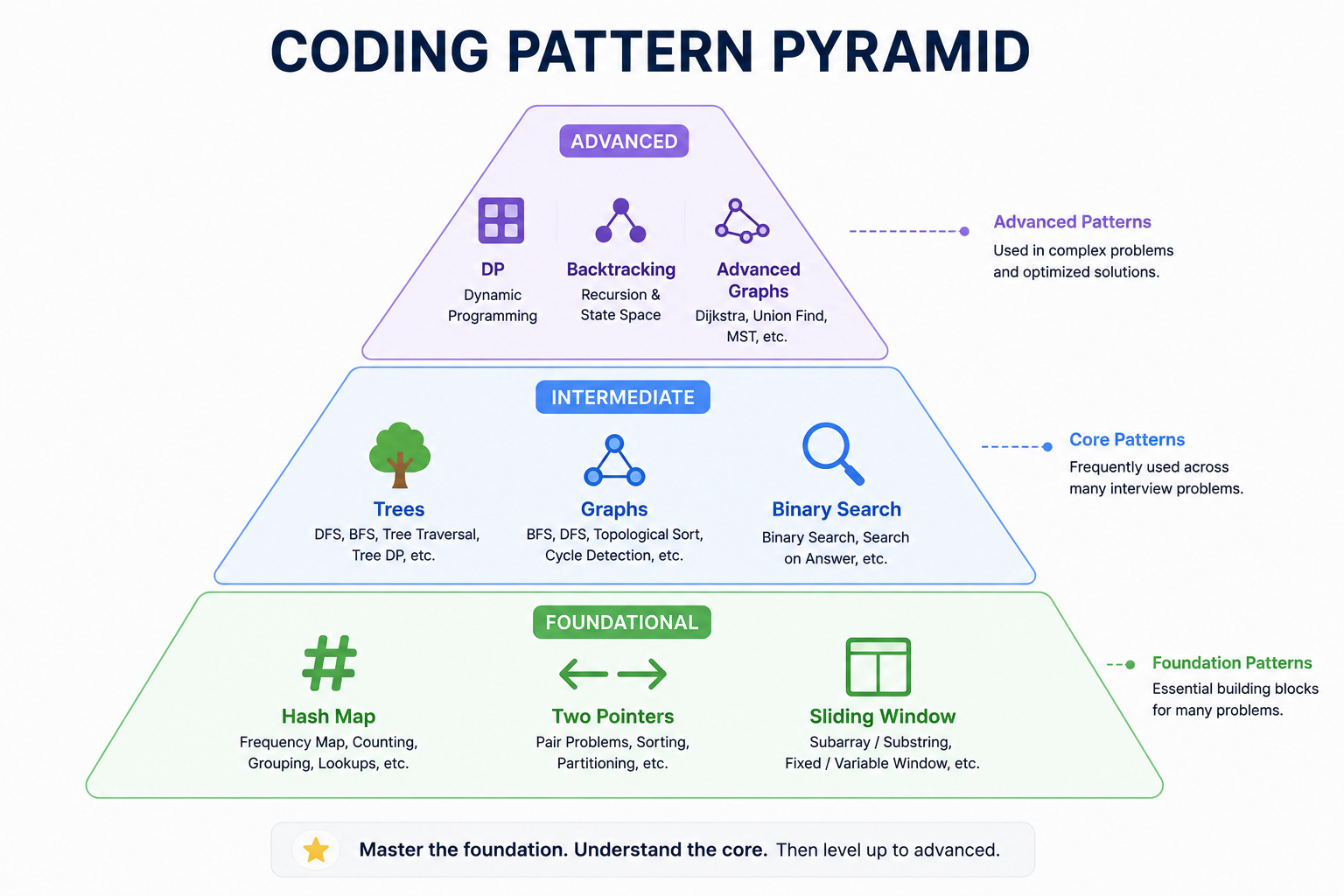
Mastering Tier 1 and Tier 2 covers a huge percentage of interview questions.
Many candidates spread themselves too thin.
Strong candidates build depth first.
The Biggest Interview Breakthrough
Almost every successful candidate experiences a moment when things suddenly click.
Not because they solved enough problems.
Not because they discovered a secret trick.
Because they stopped seeing individual questions.
They started seeing patterns.
A candidate might solve:
Two Sum
Contains Duplicate
Group Anagrams
At first they look unrelated.
Later they all become:
Hash Map.
The same transformation happens everywhere.
Longest Substring.
Minimum Window Substring.
Permutation in String.
They all become:
Sliding Window.
That shift changes everything.
What to Do After Reading This
Do not immediately solve fifty more problems.
Instead, build your own decision tree.
Take every problem you solve and classify it.
Ask:
What clue revealed the pattern?
What eliminated other patterns?
Could I identify this pattern faster next time?
This approach develops the skill that interviews actually reward.
Recognition.
Not memorization.
The Mental Model That Strong Candidates Use
When a strong candidate sees a new problem, the internal conversation often sounds like this:
“What is the input?”
“Is it sorted?”
“Do I need a pair?”
“Is it a contiguous range?”
“Do I need levels?”
“Do I need shortest path?”
“Are there repeated subproblems?”
Those questions create structure.
Structure reduces uncertainty.
And reduced uncertainty leads to better decisions.
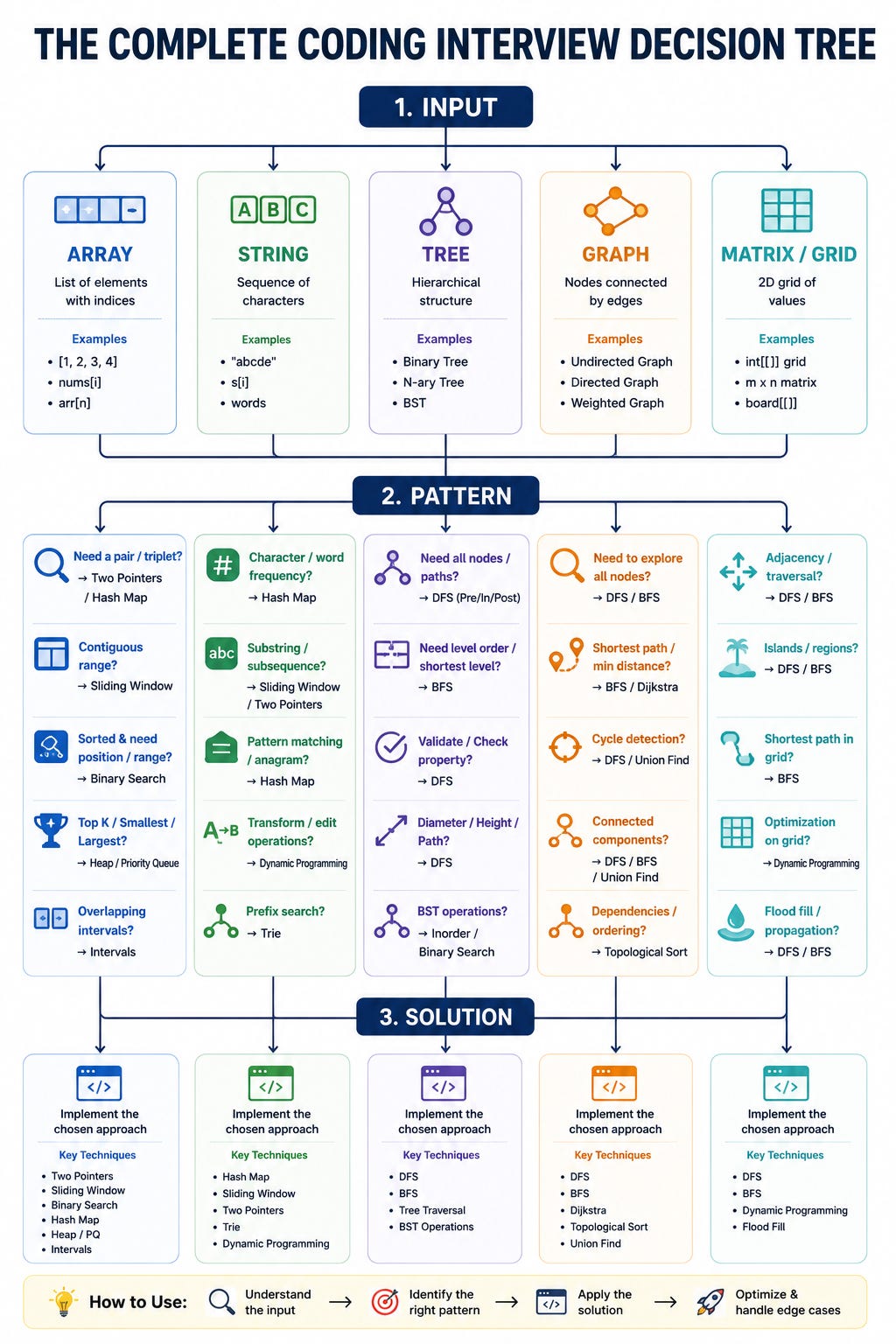
Final Thoughts
LeetCode patterns feel confusing because most people learn them as isolated techniques.
They learn Sliding Window.
Then Hash Maps.
Then BFS.
Then Dynamic Programming.
Each pattern makes sense individually.
The confusion appears when choosing among them.
The missing piece is not another pattern.
The missing piece is a decision tree.
Strong candidates do not solve every problem from scratch.
They classify first.
They eliminate possibilities.
They recognize signals.
They narrow the search space.
Only then do they start solving.
Once you build that habit, interview questions stop feeling random.
You begin seeing structure.
You begin recognizing patterns.
And that is the moment LeetCode starts becoming dramatically easier.