
Sliding Window vs Two Pointers: The Difference Candidates Miss
A Practical Guide to Recognizing the Right Pattern in Coding Interviews Before You Write a Single Line of Code

If you spend enough time preparing for coding interviews, you’ll eventually encounter a confusing realization.
Many array and string problems seem to be solved using either Sliding Window or Two Pointers.
Sometimes the solutions even look similar.
You see two indices moving through an array. You see O(n) complexity. You see pointers advancing and retreating. Yet interviewers, solution guides, and preparation courses often classify these problems into different patterns.
This is where many candidates get stuck.
They learn the mechanics of both patterns but never fully understand the difference between them. As a result, they approach new questions with uncertainty. They know the tools exist, but they struggle to identify which one belongs to the problem in front of them.
The consequence is predictable.
Instead of recognizing the correct pattern within a minute, they spend ten minutes experimenting with approaches. By the time they identify the right solution, valuable interview time has already disappeared.
The good news is that Sliding Window and Two Pointers are not nearly as complicated as they initially appear.
The confusion usually comes from focusing on implementation instead of purpose.
Once you understand why each pattern exists, recognizing them becomes much easier.
Why Candidates Confuse These Patterns
Let’s start with the reason the confusion exists.
Both patterns often involve two indices.
Consider this code fragment:
left = 0
right = 0
Immediately, many candidates think:
“This must be Sliding Window.”
But the presence of two indices does not automatically mean Sliding Window.
Similarly, many Two Pointer solutions also use a left pointer and a right pointer.
The implementation details overlap.
The intent does not.
That distinction matters.
Interview success depends far more on recognizing intent than memorizing code structures.
Strong candidates identify what the problem is asking before they think about implementation.
Weak candidates focus on code first and pattern recognition second.
The result is unnecessary confusion.
The Core Purpose of Two Pointers
The Two Pointers pattern exists to analyze relationships between elements.
That is the key idea.
You are usually comparing, matching, pairing, merging, or evaluating elements relative to one another.
The pointers are independent.
Each pointer exists because it represents a different element or position.
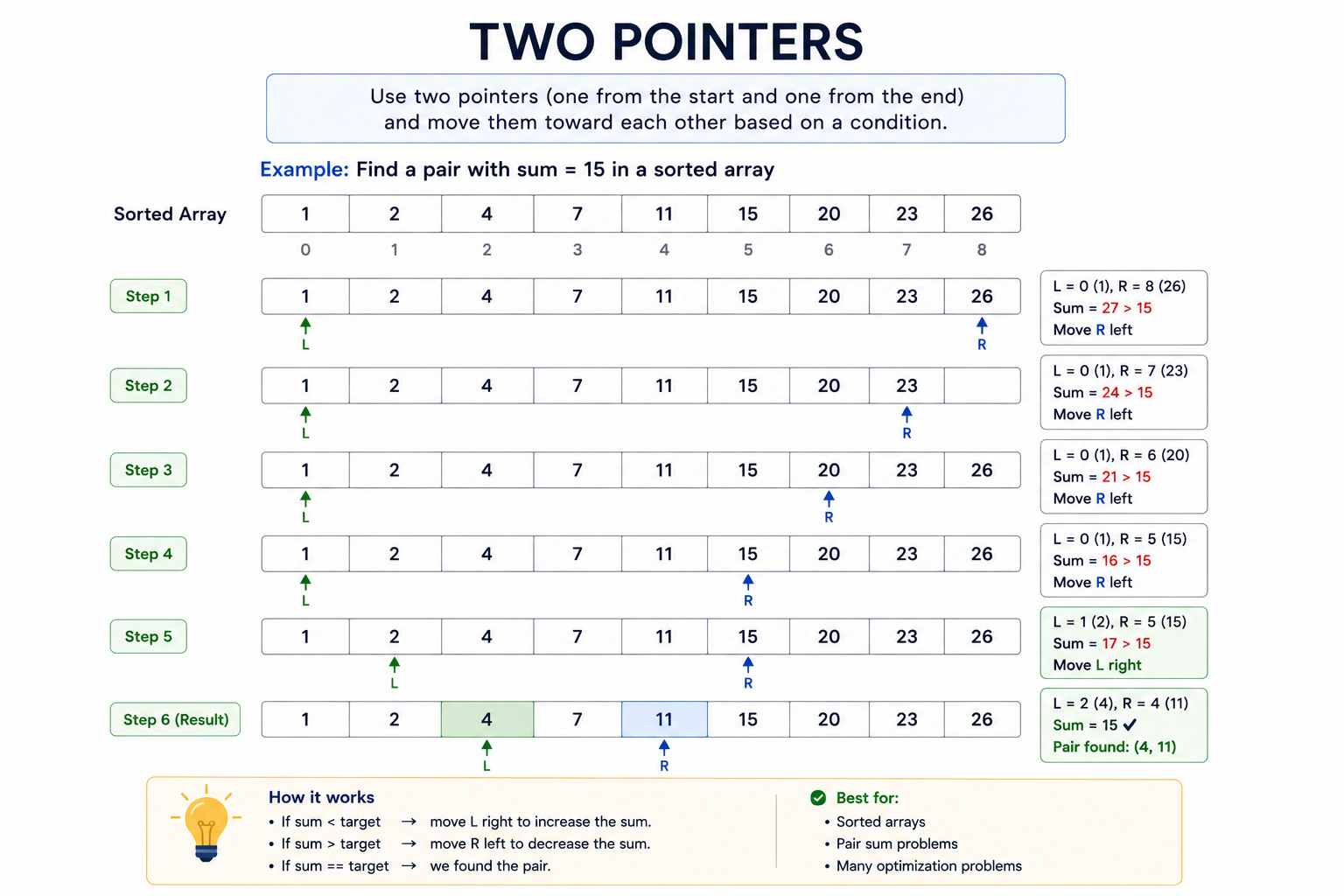
Consider the classic Two Sum II problem. You are given a sorted array.
The task is to find two numbers that add up to a target value.
The solution looks like this:
left  → beginning
right → end
Then:
If the sum is too small, move left.
If the sum is too large, move right.
If the sum matches, return the answer.
Notice what is happening.
The goal is not maintaining a range.
The goal is comparing two elements.
The pointers represent two separate values.
This idea appears repeatedly in interview questions.
Common Signals for Two Pointers
Certain clues appear again and again. Strong candidates learn to recognize them quickly.
Signal 1: Pair Relationships
Examples include:
Find two numbers
Find a pair
Find a triplet
Find matching values
When the problem revolves around relationships between elements, Two Pointers becomes a strong candidate.
Signal 2: Sorted Arrays
Interviewers rarely provide sorted input without a reason.
A sorted array creates opportunities to move pointers intelligently.
Problems such as:
Two Sum II
Three Sum
Container With Most Water
all rely heavily on this property.
Signal 3: Opposite Ends
Whenever pointers start at different ends of a structure, Two Pointers should immediately enter your mind.
For example:
left → beginning

right → end
This setup appears constantly in Two Pointer problems.
The Core Purpose of Sliding Window
Now let’s compare that with Sliding Window.
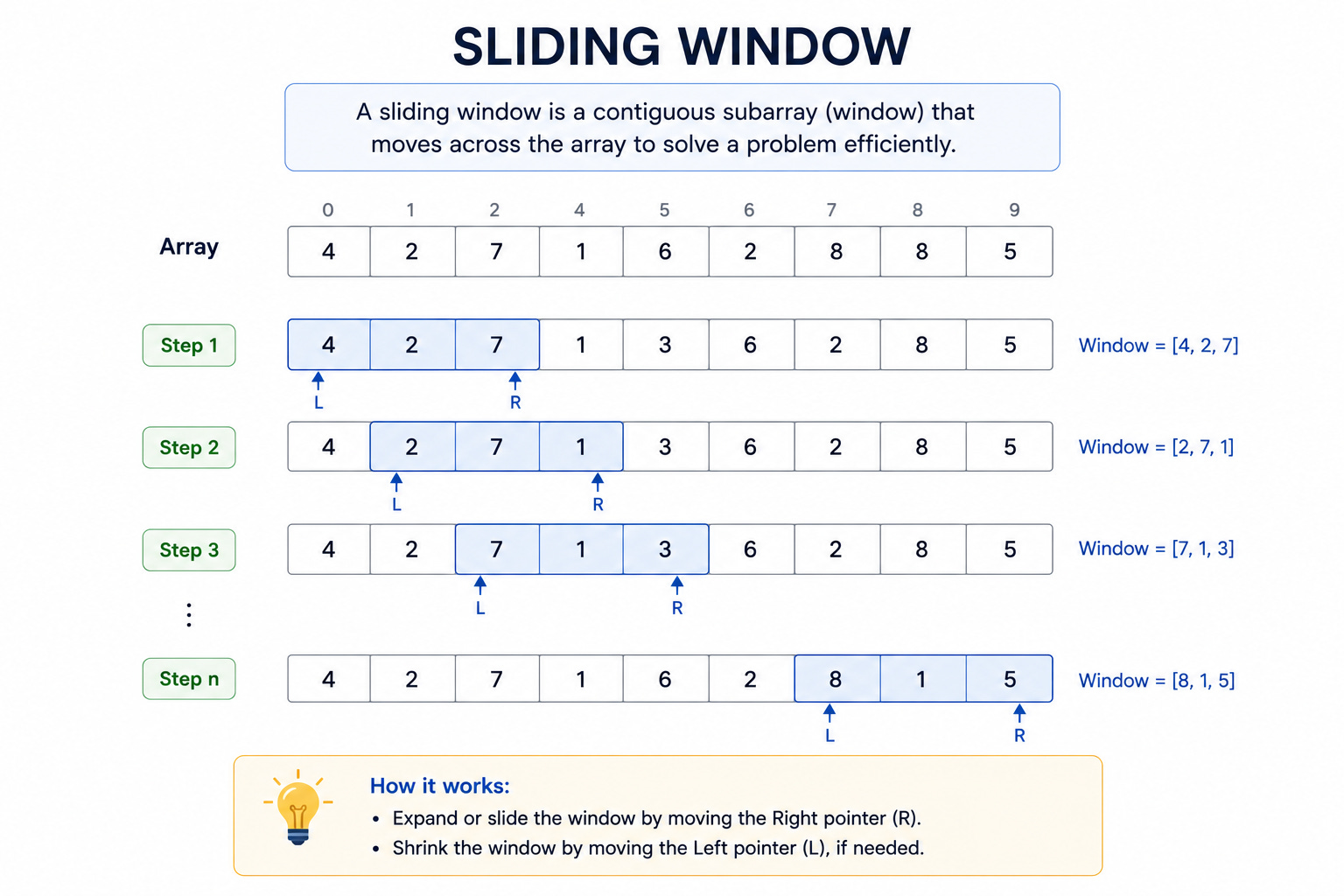
Sliding Window exists for a completely different reason. Its purpose is maintaining a contiguous range.
The relationship between elements matters less than the range itself.
The window becomes the primary object.
Instead of analyzing individual positions, you are analyzing a segment.
This distinction is subtle but extremely important.
Consider the problem:
Longest Substring Without Repeating Characters.
Most candidates eventually learn the solution.
The more important question is:
Why is Sliding Window the correct pattern?
The answer is simple.
The problem asks about a contiguous substring.
A substring is a range.
Sliding Window specializes in ranges. That single observation often identifies the pattern before any coding begins.
A Different Mental Model
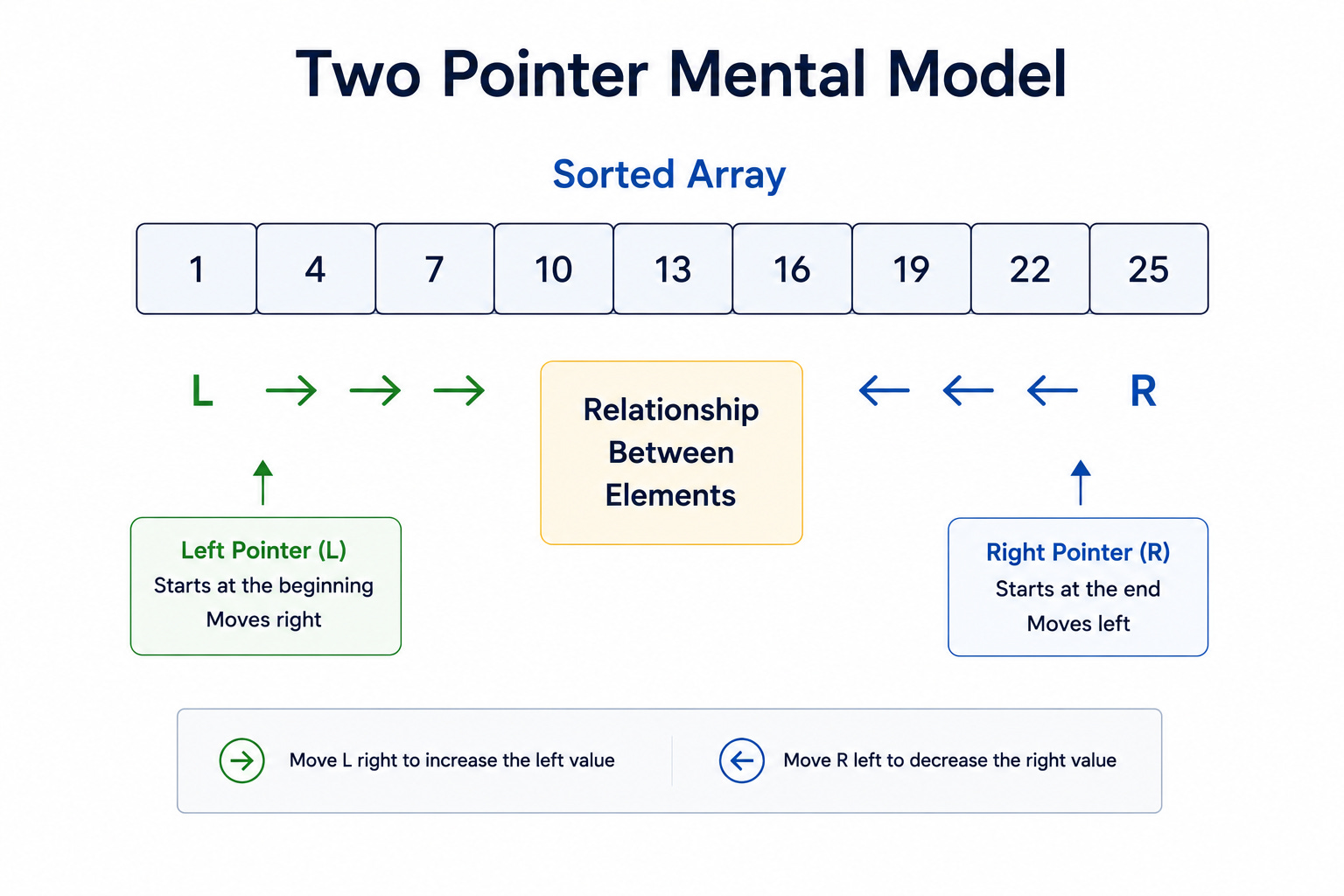
When solving Two Pointer problems, think:
“What relationship exists between these elements?”
When solving Sliding Window problems, think:
“What is happening inside this range?”
The mental models are different.
Two Pointers focuses on elements.
Sliding Window focuses on segments.
Once candidates internalize this distinction, many pattern-recognition problems disappear.
Visualizing the Difference
Imagine an array:
[1, 3, 5, 7, 9]
A Two Pointer problem might compare:
1 and 9

3 and 7
The goal is understanding relationships.
Now imagine:
[1, 3, 5]
Then:
[3, 5, 7]
Then:
[5, 7, 9]
This is Sliding Window.
The focus is the range.
Different mindset.
Different objective.
Different pattern.
The Most Common Sliding Window Signals
Interviewers often provide clues without realizing it.
Strong candidates know how to spot them.
Signal 1: Subarray
This word appears constantly.
Examples:
Maximum Sum Subarray
Minimum Size Subarray
Longest Subarray
Subarray almost always implies a contiguous range.
Contiguous ranges strongly suggest Sliding Window.
