
Stop Preparing for Google. Prepare for Engineering Interviews
Optimizing your prep for one specific company's process is one of the most common and most damaging mistakes in interview preparation. Here is the reframe that fixes it.


Ask a group of engineers how they are preparing for interviews and most will give you a company name.
“I’m prepping for Google.”
“I’m grinding for FAANG.”
“I have a Meta loop in three weeks.”
The company becomes the target, the preparation becomes calibration to that company’s specific rubric, and the entire effort narrows to a point.
This is understandable.
Companies have reputations for specific processes.
Google is known for abstract algorithm problems and systems-thinking questions at scale.
Meta is known for product-sense coding and behavioral emphasis. Stripe is known for practical, production-shaped engineering.
Amazon is known for weaving Leadership Principles through every round. Knowing these things feels like actionable intelligence, and it is. But it becomes a trap the moment you let company-specific prep replace foundational engineering-interview prep rather than layer on top of it.
The trap springs in three ways.
You prepare for one company and your loop gets cancelled or your timeline shifts, leaving you calibrated for a process that no longer exists on your schedule.
You prepare for one company and get an offer from a different one you applied to opportunistically, and you walk in under-prepared for a process you never studied.
Or, most insidiously, you over-index on the surface features of a company’s process while neglecting the fundamentals underneath every engineering interview, which means you perform worse even at the company you specifically prepared for.
The fix is not to stop caring about company-specific preparation. It is to get the order of operations right: prepare for engineering interviews first, prepare for the specific company second.
This post explains what that means and why it changes everything.
What An Engineering Interview Actually Tests
Companies differ in surface: the number of rounds, the emphasis on system design versus coding, the weight of behavioral conversation, the specific questions they tend to ask.
What they do not differ on are the underlying qualities they are evaluating.
Every engineering interview, at every company worth working at, is trying to answer the same cluster of questions about you.
Can you take an ambiguous problem and turn it into something concrete?
Can you write code that is correct, clean, and handles the real cases?
Can you reason about the cost of your solution and know when it is good enough?
Can you communicate your thinking so another engineer can follow it?
Can you handle failure gracefully, when something goes wrong, when a constraint changes, when an approach dead-ends?
And can you demonstrate the specific judgment that separates an engineer who ships reliably from one who ships impressively on average?
These questions are constant.
The format in which they are probed varies, but the underlying signal being measured does not.
Google measures it with abstract algorithm problems. Stripe measures it with practical engineering tasks.
Amazon measures it with structured behavioral conversation.
The instrument changes; the measurement does not.
This means that strong preparation for engineering interviews is strong preparation for any engineering interview, because it builds the qualities every evaluator is looking for.
Company-specific preparation, in contrast, optimizes for the instrument without necessarily improving the underlying signal.
You can learn all of Google’s common question types without becoming a better engineer, and you can become a significantly better engineer without learning anything about Google’s specific process.
The Problem with FAANG-First Preparation
The most common version of the trap is what might be called FAANG-first preparation: treating the processes of the five or six most famous technology companies as the default, calibrating your practice to their formats, and implicitly assuming that every other company you might interview at is a variation of what they do.
This assumption is wrong in both directions.
A significant fraction of strong engineering roles are not at FAANG companies, and many of those companies have fundamentally different interview formats. Some of the most technically demanding interviews in the industry are at mid-sized startups, research organizations, and infrastructure companies whose processes look nothing like a Google loop.
Preparing only for FAANG-style abstract algorithms can leave you underprepared for a three-hour take-home followed by a deep architecture discussion, or a pair-programming session on a real codebase, or a week-long project designed to simulate actual work.
And even within the FAANG tier, the variation is substantial.
A Google interview and a Meta interview and an Amazon interview are genuinely different experiences that reward genuinely different preparation.
“I’m prepping for FAANG” is not a preparation strategy; it is a grouping of six different strategies that you haven’t actually chosen between.
The deeper problem is that FAANG-first preparation can actually reduce performance on FAANG interviews.
When you orient your study around recognizing famous question types and reproducing memorized solutions, you build a shallow catalog rather than deep capability.
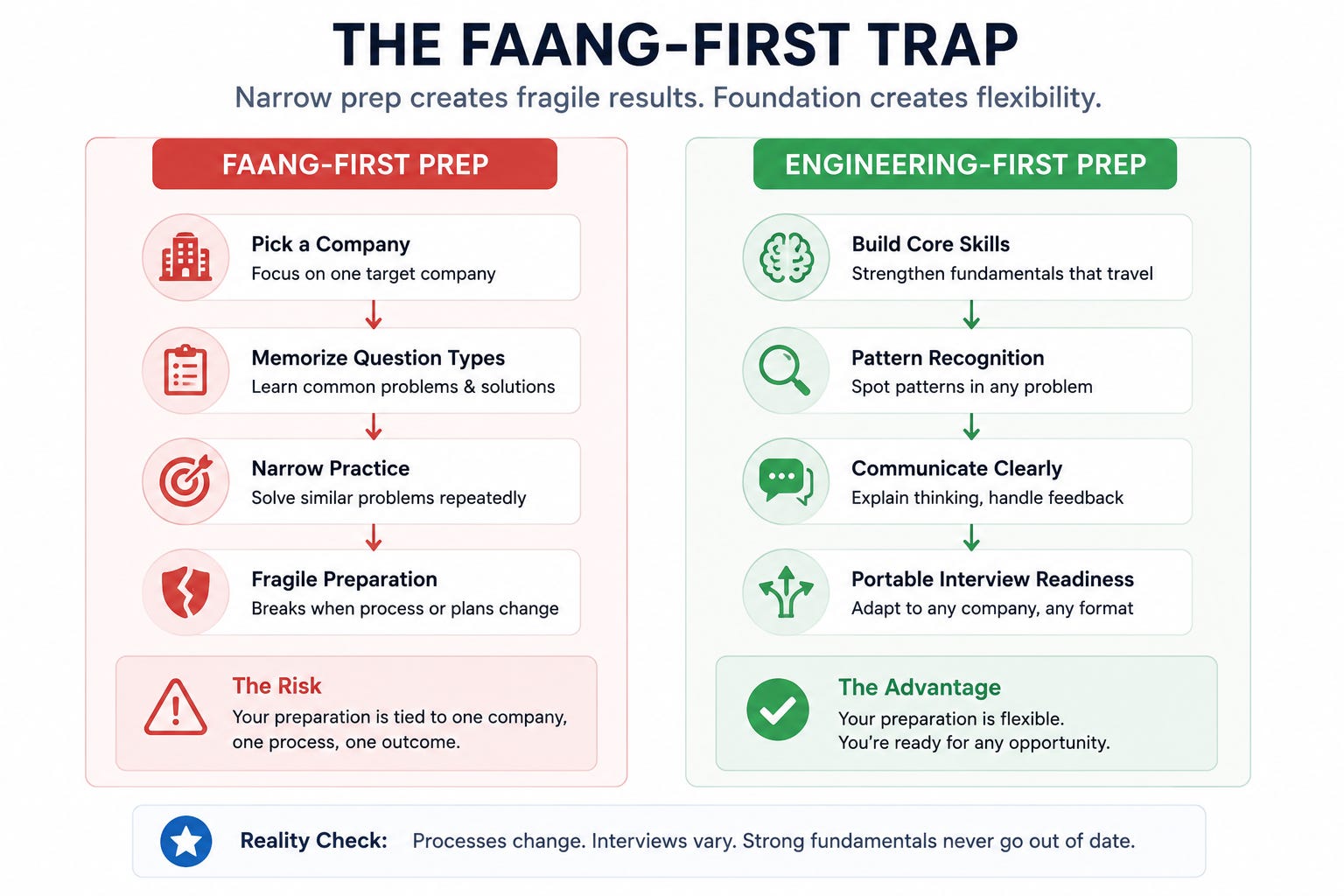
The interviewers at these companies have seen every approach in the catalog.
What moves the needle with them is not producing the known solution; it is demonstrating the reasoning that would have produced it in a world where you had never seen the problem. That reasoning comes from deep preparation for engineering interviews, not from company-specific drilling.
What Foundational Preparation Actually Looks Like
Foundational preparation builds four capabilities that every engineering interview rewards, regardless of company, format, or the specific questions asked.
The first is pattern recognition: the ability to read an unfamiliar problem and identify, within about ninety seconds, what kind of problem it is and what class of solutions applies. This is not memorizing which problems match which patterns. It is learning to read the signals, the vocabulary, the output shape, the constraints, the input structure, that problems consistently emit.
Pattern recognition built on these signals transfers to every problem you have never seen, which is what every interview hands you.
The second is problem-solving process: the habit of clarifying before coding, working a concrete example before designing, starting with a brute force before optimizing, stating the complexity of whatever you propose, and testing before you are asked to.
This process, run consistently, produces good outcomes across all interview formats because it reflects good engineering judgment that evaluators at every company are trained to notice and reward.
The third is communication under pressure: the ability to narrate your thinking continuously, to explain tradeoffs as you encounter them, to handle being wrong without shutting down, and to ask clarifying questions naturally rather than awkwardly.
This skill is measured explicitly in every behavioral round and implicitly in every coding and design round.
A strong technical answer delivered silently scores lower than a slightly weaker one explained clearly.
The fourth is genuine versatility: comfort with the full range of problem types that engineering interviews draw from, arrays and strings, trees and graphs, dynamic programming, system design fundamentals, rather than deep specialization in the subset your target company emphasizes.
Versatility matters because you never know exactly what you will get, and because the companies whose processes you did not specifically study may give you the best offers.
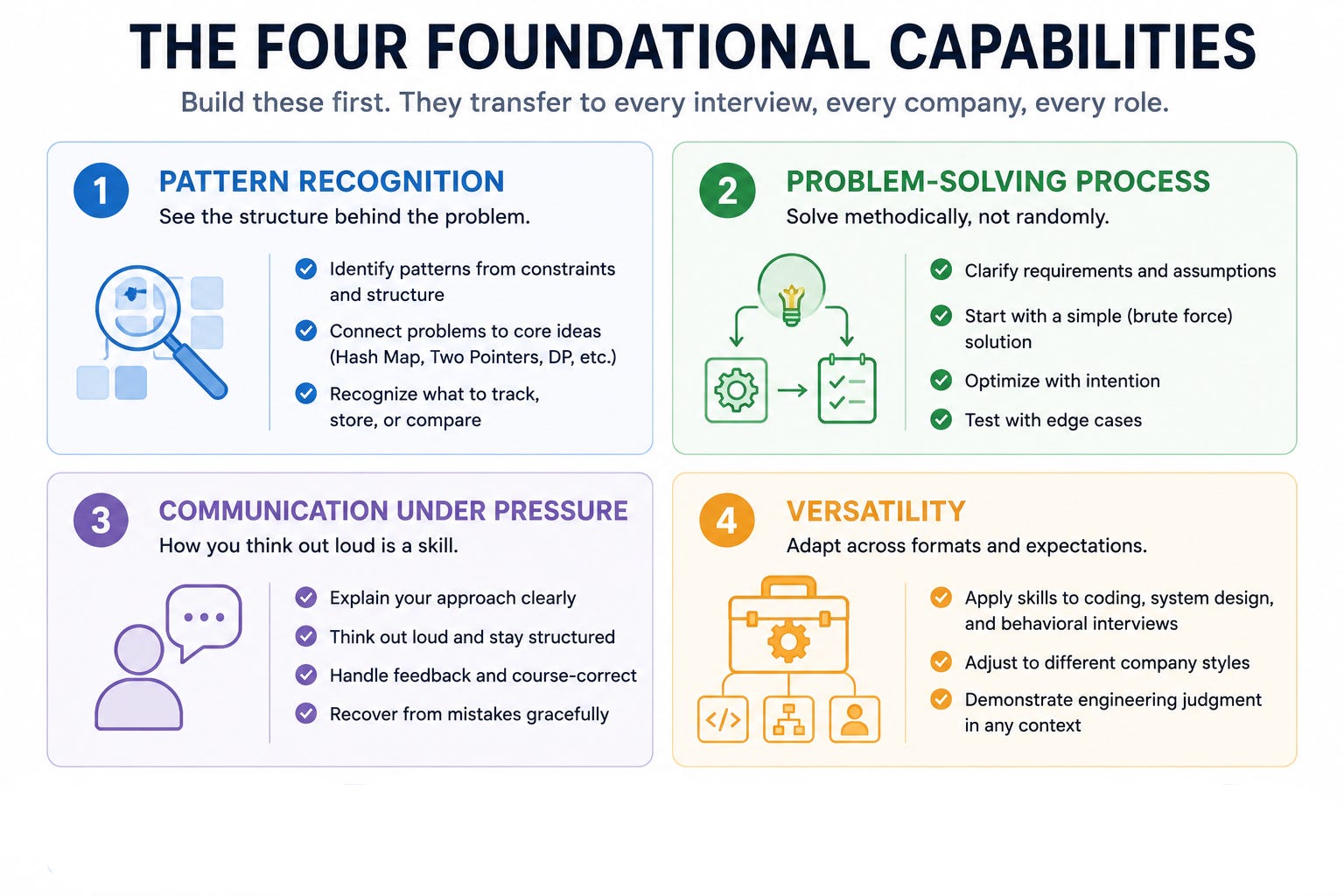
These four capabilities are what make someone genuinely interview-ready across the industry, not just prepared for one loop.
When and How Company-Specific Preparation Is Actually Valuable
None of this means ignoring the specific company you are interviewing at. Company-specific preparation has real value; the point is that it belongs in the second layer, not the first.
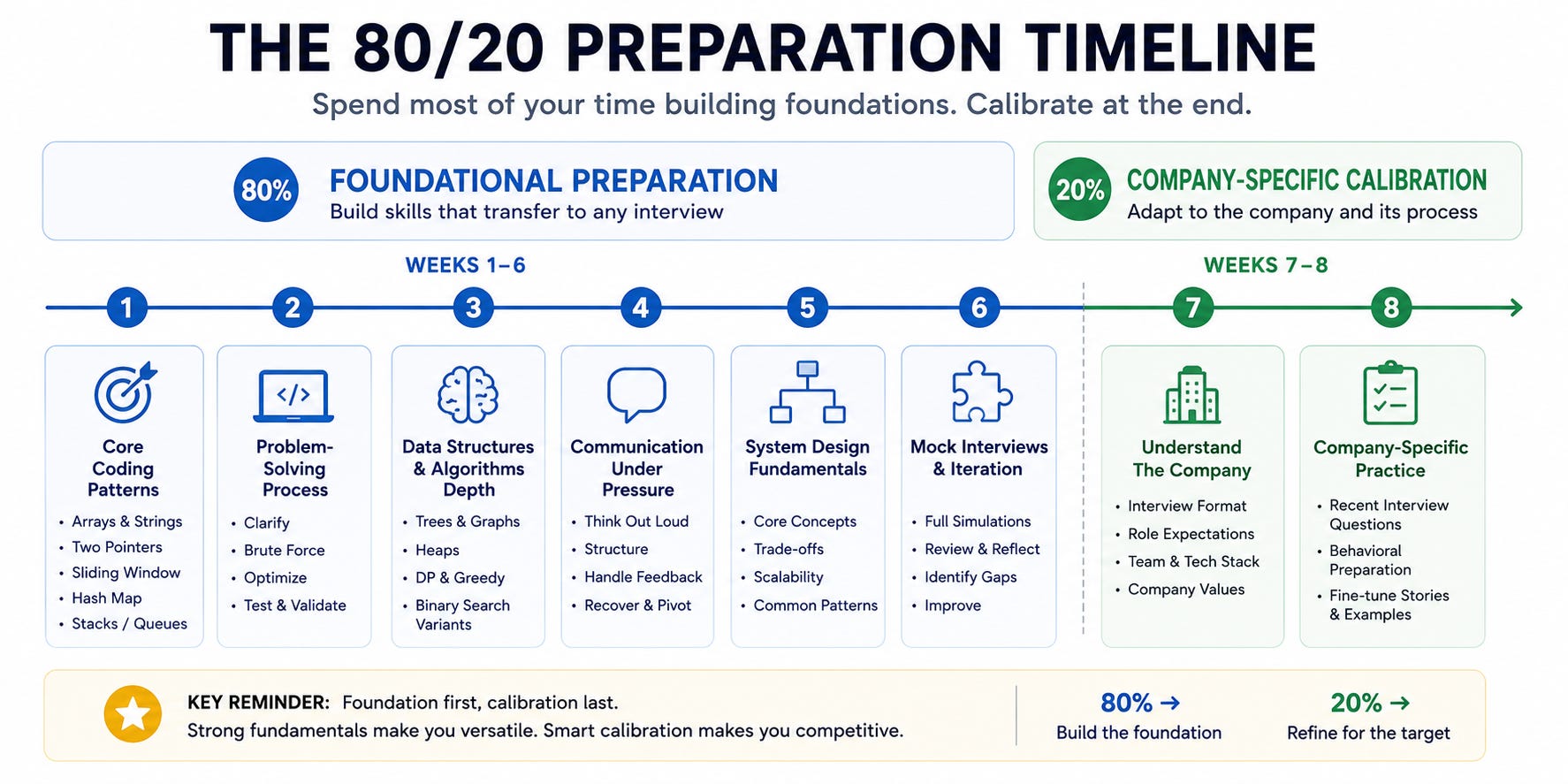
The first layer, the foundational capabilities above, typically takes most of your preparation time and should be built independently of any specific target.
The second layer, company-specific calibration, typically takes a fraction of that time and is best done in the final week or two before a loop.
What belongs in the second layer is the things that genuinely differ between companies and cannot be inferred from foundational preparation.
Understanding a company’s emphasis (whether they weigh system design heavily, whether behavioral conversation is its own scored round or just a warmup, whether coding is abstract or practical) lets you allocate your remaining time intelligently and walk in with the right mental model of what to expect.
Reading recent candidate reports gives you a realistic picture of what the experience is like and what questions have come up.
Understanding the company’s values and mission helps you prepare for mission-alignment questions that most companies ask in some form.
This second-layer preparation is genuinely worth doing. It just does not substitute for the first layer, and it is far more effective when the first layer is already solid.
The Specific Case for Non-FAANG Interviews
One more argument for foundational-first preparation: the most underrated opportunities in engineering are frequently not at the most famous companies.
The range of technically interesting and financially rewarding roles outside FAANG is enormous, and the interview processes that guard them are often more directly tied to the actual work.
A company building critical infrastructure might ask you to debug a real system under time pressure.
A well-funded startup might give you a take-home project and ask you to present your design decisions.
A research organization might pair you with a senior engineer for a day of actual work. These are different from a Google loop, and a candidate who prepared only for abstract algorithm problems will be genuinely surprised by them.
Foundational preparation handles all of these better than company-specific preparation handles any one of them, because the underlying capabilities, clear thinking, clean code, strong communication, sound design judgment, are exactly what every format is trying to measure.
The additional practical argument is optionality. Engineering job searches rarely proceed exactly as planned.
Companies reject timelines.
Offers come from unexpected places.
The candidate who built foundational capability is ready for every opportunity that materializes.
The candidate who calibrated narrowly to one company is ready for only that one, and at risk if the process changes or the timeline shifts.
The Reframe in Practice
Concretely, what does it look like to prepare for engineering interviews rather than for a specific company?
It looks like building genuine pattern recognition across the full range of topics that coding interviews draw from, not just the subset your target company emphasizes. It looks like practicing the problem-solving process consistently, on every problem you touch, until clarifying before coding and stating complexity after are habits rather than deliberate choices.
It looks like rehearsing communication out loud, regularly, because thinking out loud is a performance skill that only performance practice builds.
It looks like getting comfortable with system design fundamentals as a domain rather than memorizing specific architectures.
And it looks like doing company-specific research as a late-stage calibration step, not as the organizing frame for all of your preparation.
The practical implication for timeline: if you have eight weeks to prepare and a specific company in mind, spend approximately six of those weeks on foundational preparation and two on company-specific calibration.
If you do not have a specific company in mind, spend all eight weeks on foundational preparation, because the company-specific layer will be fast to add once you have a target and a timeline.
Frequently Asked Questions
Does this mean I should ignore what companies are known for?
No. Knowing that one company weights behavioral heavily, or that another runs a debugging round, is useful for allocating your time in the final weeks. The point is that this company-specific knowledge has diminishing returns without foundational capability underneath it, and that foundational capability is what most people underinvest in.
What if I only want to work at one specific company?
Then prepare for engineering interviews first and spend more of your second-layer time on that company than you would otherwise. The order of operations still applies: the foundational capabilities make the company-specific preparation more effective, not less.
Is FAANG preparation ever the right frame?
It can be a useful shorthand for “I should know data structures, algorithms, and system design fundamentals,” which is approximately the curriculum for the first layer of preparation. The problem is when it stops being a shorthand and starts being the actual goal, because that is when the memorization-of-famous-questions trap becomes live.
What about companies with very unusual processes?
If a company’s process is genuinely unusual (a week-long project, a pair-programming session on a real codebase, a research presentation), foundational preparation is not sufficient and specific preparation for that format is warranted. But those companies are still measuring foundational capabilities through an unusual instrument, so the underlying preparation still matters and is not wasted.
How do I know when my foundational preparation is solid enough to add the company-specific layer?
A reasonable test: can you read an unfamiliar problem and name a plausible approach in about ninety seconds? Can you implement that approach cleanly, handle the edge cases, state the complexity, and walk through a test, all while talking? Can you design a basic system with a load balancer, a database, and a cache, and discuss the tradeoffs, without being prompted? If yes to all three, your foundation is solid enough to layer company-specific preparation on top.
The Bottom Line
Preparing for Google rather than for engineering interviews is optimizing the instrument while neglecting the signal.
Every engineering interview, at every company worth working at, is measuring the same underlying qualities: pattern recognition under pressure, clean code, sound judgment about tradeoffs, and clear communication. These qualities are built through foundational preparation, not company-specific drilling.
Company-specific preparation is real and worth doing, but it belongs in the second layer.
The first layer, foundational engineering-interview capability, is what makes the second layer effective.
Candidates who reverse the order spend most of their time on the part that has the least return, and they pay for it when their loop gets cancelled, when an unexpected offer appears, or when the interview demands something the catalog does not contain.
Prepare for engineering interviews. Then calibrate for the company.
In that order, and that order matters.
Which part of foundational preparation do you find hardest to build, pattern recognition, the problem-solving process, communication under pressure, or versatility across topics?